by Will & Ariel Durant
More Recommenders
Author and entrepreneur

American bicycle racer

Founder of Bridgewater Associates
Recommended by 12 notable people, including Naval Ravikant and Tim Ferriss
Check price on AmazonRecommended by public sources
Amazon availability
See customer reviews on Amazon →This 120-page book reads like a series of distilled lectures from the authors of the monumental 'Story of Civilization.' Durant offers bold, aphoristic reflections on geography, biology, morality, economics, and war, seeking timeless patterns. What works best is a provocative, big-picture perspective that can reframe how you think about history. The limitation is its mid-century lens: assumptions about race, gender, and human nature now feel archaic, and the grand, unsupported claims will frustrate readers wanting careful, source-cited analysis. Useful as a philosophical spark, not a rigorous guide.
This summary and audience guidance are AI-generated from the book's description and its recommendation history, last updated May 2026. Recommendations, quotes and sources elsewhere on this page come from published material and are not generated.
Written by the authors of the 10 volume *The Story of Civilization*, this short (fewer than 120 pages) work notes "events and comments that might illuminate present affairs, future probabilities, the nature of man, and the conduct of states." Its 13 chapters discuss historiography (what is history), history and the earth, history and biology, race, character, morals, religion, economics, socialism, government, war, growth and decay. The final chapter asks, "Is progress real?"
Difficulty:hard
Check formats, pricing, and availability options for Kindle, physical print, or audiobooks directly.
View available editions on AmazonWhy recommended
Recommended by 18 sources and appears in Books Recommended by Investors, Books Recommended by Writers, and Books Recommended by Billionaires.
People and public figures who have recommended this book.
Recommendation proof is sourced from public posts, interviews, reading lists, and cited references.
Check formats, pricing, and availability options directly on Amazon.
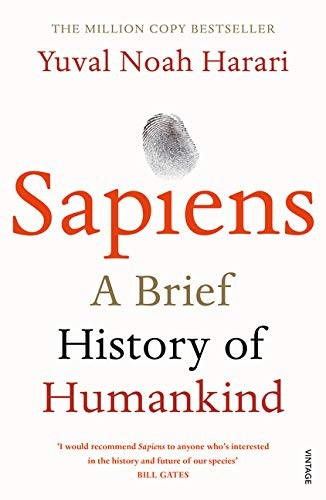
Consider Sapiens by Yuval Noah Harari. Recommended by 101 sources.
“A sweeping narrative history of Homo sapiens from the Cognitive Revolution to the present. Harari argues that what makes humans dominate the planet is not physical strength but collective myths: shared fictions like money, religion, and nations that allow millions of strangers to cooperate. The book moves fast through 70,000 years, making big, debatable claims about agriculture, empire, capitalism, and happiness. It is less a history textbook than a provocative essay in chronological form, and best read as an argument rather than a reference.”
Each recommendation is collected from a public source — interviews, articles, or curated lists — and linked to its original URL. Books with many verifiable recommendations from respected people rank higher.