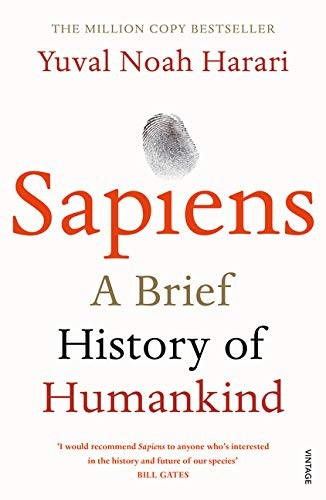
A Brief History of Humankind
by Yuval Noah Harari
More Recommenders

Author; founder of CD Baby

Technology executive and investor

Author of Atomic Habits

founder and CEO of Gumroad
Recommended by 12 notable people, including Naval Ravikant and Nat Eliason
Check price on AmazonRecommended by public sources
Amazon availability
See customer reviews on Amazon →A sweeping narrative history of Homo sapiens from the Cognitive Revolution to the present. Harari argues that what makes humans dominate the planet is not physical strength but collective myths: shared fictions like money, religion, and nations that allow millions of strangers to cooperate. The book moves fast through 70,000 years, making big, debatable claims about agriculture, empire, capitalism, and happiness. It is less a history textbook than a provocative essay in chronological form, and best read as an argument rather than a reference.
This summary and audience guidance are AI-generated from the book's description and its recommendation history. Recommendations, quotes and sources elsewhere on this page come from published material and are not generated.
Difficulty:medium
Length:520 pages (Long)
Check formats, pricing, and availability options for Kindle, physical print, or audiobooks directly.
View available editions on AmazonWhy recommended
Recommended by 101 sources and appears in Art History, Books Recommended by Founders, and Books Recommended by Bill Gates.
People and public figures who have recommended this book.
Recommendation proof is sourced from public posts, interviews, reading lists, and cited references.
Check formats, pricing, and availability options directly on Amazon.
Art History
Topic93 books
Books Recommended by Founders
Category75 books
Books Recommended by Bill Gates
Category75 books
Books Recommended by Investors
Category75 books
Books Recommended by CEOs
Category75 books
Books Recommended by Writers
Category75 books
Books Recommended by Billionaires
Category75 books
Books Recommended by Naval Ravikant
Category75 books
Consider Accidental Presidents by Jared Cohen. Recommended by 10 sources.
“Accidental Presidents offers eight narrative portraits of men who succeeded to the U.S. presidency without election, using anecdote-rich scenes and readable context to show how personality and circumstance interact with office power. It’s strongest as a set of self-contained stories that make succession stakes concrete for non-specialist readers; it does not prioritize dense archival argument or exhaustive methodology, so expect some interpretive generalizations and repeated themes across cases. Use it for fast historical orientation rather than scholarly deep-dives.”
Each recommendation is collected from a public source — interviews, articles, or curated lists — and linked to its original URL. Books with many verifiable recommendations from respected people rank higher.