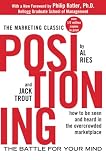
Positioning
The Battle for Your Mind
by Al Ries
6 more
More Recommenders
“@hunteransley @paulg I mean not really. You can simultaneously have a great message (the left may not) but still have ways of framing it negatively (the right does). Great book on this: | Positioning, and The 22 Immutable Laws of Marketing by Al Ries and Jack Trout. Anyone who wants to start a business with impact needs to read these books. | Revisited an old favorite by @DKThomp The concept of “MAYA”, together with the book “Positioning” by Al Ries formed most of my views for how to craft messages or design things | “Positioning” is one of the most important books I’ve read. “The basic idea is not to create something new and different, but to manipulate what’s already in the mind, to retie the connections that already exist.” E.g. this is how we came up with the term “Custom Indexing””
Source →“@hunteransley @paulg I mean not really. You can simultaneously have a great message (the left may not) but still have ways of framing it negatively (the right does). Great book on this: | Positioning, and The 22 Immutable Laws of Marketing by Al Ries and Jack Trout. Anyone who wants to start a business with impact needs to read these books. | Revisited an old favorite by @DKThomp The concept of “MAYA”, together with the book “Positioning” by Al Ries formed most of my views for how to craft messages or design things | “Positioning” is one of the most important books I’ve read. “The basic idea is not to create something new and different, but to manipulate what’s already in the mind, to retie the connections that already exist.” E.g. this is how we came up with the term “Custom Indexing””
Source →Recommended by 8 notable people, including Ev Williams and Sophie Bakalar
Check price on AmazonProof-backed recommendation
Amazon availability
Reading Profile
Should I read this?
Witty and fast-paced, Positioning feels like a marketing memo about planting a simple, memorable place for a brand in a skeptical, mediablitzed public's mind. Its useful core is a set of portable heuristics for choosing a single message that reflects your strengths and concedes competitors' claims. The book leans on ad-era examples and blunt prescriptions, so parts read repetitive or anchored to pre-digital media. Take away crisp headline rules, but expect to adapt them heavily for social and digital channels.
Read this if...
- •brand manager launching a new SKU in a crowded retail category who needs a concise one-line position to brief creative and sales quickly
- •founder crafting pitch and first marketing copy who must explain differentiation in two sentences to noisy prospects
- •marketing instructor assembling a class module on historical advertising practice who wants a clear, practitioner-oriented source to prompt discussion
Skip this if...
- •you'll likely put it down when the same advertising anecdotes keep returning and examples feel tied to analogue media — that repetition is a common drop-off point
- •annoying if you prefer modern, digital-first case studies and tactical, step-by-step exercises — the book lacks hands-on exercises and platform-specific guidance
- •frustrating if you dislike prescriptive, declarative advice or want research citations — the tone is opinion-heavy and sales-oriented rather than academically cautious
The first book to deal with the problems of communicating to a skeptical, mediablitzed public, Positioning describes a revolutionary approach to creating a "position" in a prospective customer's mindone that reflects a company's own strengths and weaknesses as well as those of its competitors. Writing in their trademark witty, fastpaced style, a...
Before You Buy
Reading Specifications
Difficulty:hard
Audience Fit
- brand manager launching a new SKU in a crowded retail category who needs a concise one-line position to brief creative and sales quickly
- founder crafting pitch and first marketing copy who must explain differentiation in two sentences to noisy prospects
- marketing instructor assembling a class module on historical advertising practice who wants a clear, practitioner-oriented source to prompt discussion
- you'll likely put it down when the same advertising anecdotes keep returning and examples feel tied to analogue media — that repetition is a common drop-off point
- annoying if you prefer modern, digital-first case studies and tactical, step-by-step exercises — the book lacks hands-on exercises and platform-specific guidance
- frustrating if you dislike prescriptive, declarative advice or want research citations — the tone is opinion-heavy and sales-oriented rather than academically cautious
Check formats, pricing, and availability options for Kindle, physical print, or audiobooks directly.
View available editions on AmazonKey themes
Why recommended
Recommended by 10 sources and appears in Advertising, Product Marketing, and Branding.
Recommended by notable people
People and public figures who have recommended this book.
Recommendation Signals
Recommendation proof is sourced from public posts, interviews, reading lists, and cited references.
Aaron Levie
“@hunteransley @paulg I mean not really. You can simultaneously have a great message (the left may not) but still have ways of framing it negatively (the right does). Great book on this: | Positioning, and The 22 Immutable Laws of Marketing by Al Ries and Jack Trout. Anyone who wants to start a business with impact needs to read these books. | Revisited an old favorite by @DKThomp The concept of “MAYA”, together with the book “Positioning” by Al Ries formed most of my views for how to craft messages or design things | “Positioning” is one of the most important books I’ve read. “The basic idea is not to create something new and different, but to manipulate what’s already in the mind, to retie the connections that already exist.” E.g. this is how we came up with the term “Custom Indexing””
View sources (4) ▾80%
Appears In
Not sure if this is the right fit?
Consider The Hard Thing About Hard Things by Ben Horowitz. Recommended by 60 sources.
“A blunt, conversational tour through the worst parts of building a company. Horowitz shares personal stories from his own startup failures and recoveries, offering practical wisdom on layoffs, pivots, CEO loneliness, and managing when times are bad. The value is in the honest, experience-based insight you won't get from business school. The limitation is its narrow focus on venture-backed tech startups—if you're not in that world, some advice may feel irrelevant. Reads like a wise mentor telling you what nobody else will.”
Similar books
The Hard Thing About Hard Things
Ben HorowitzThe Innovator's Dilemma
Clayton M. ChristensenGood To Great
Jim CollinsCrossing the Chasm
Geoffrey A. Moore
Influence
Robert Cialdini
Don't Make Me Think
Steve Krug
Creativity, Inc.
Ed CatmullDeep Work
Cal NewportHow recommendation signals are reviewed
Each recommendation is collected from a public source — interviews, articles, or curated lists — and linked to its original URL. Books with many verifiable recommendations from respected people rank higher.