BookMentionsBookMentions
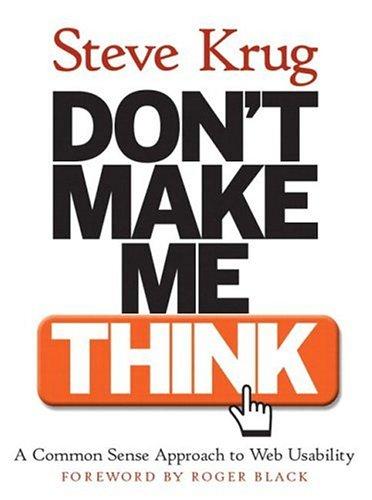
Don't Make Me Think
15 recommendations

Don't Make Me Think

A Common Sense Approach to Web Usability

by Steve Krug

Recommended by Brian Armstrong, Nir Eyal +
8 more

More Recommenders

A

A framework to simulate how customers experience your product, especially the moments of confusion. | About usability and making software and user interfaces that are friendly to people. | Still the best book on web design ever published, IMO, is "Don't Make Me Think" by @skrug on sale for 64% off | The simplest book I recommend everyone to read when they want to do design. Don't Make Me Think by Steve Krug | The single best book on usability I've ever read." "If you choose to read only one book on usability, choose this one.

Source →
J

A framework to simulate how customers experience your product, especially the moments of confusion. | About usability and making software and user interfaces that are friendly to people. | Still the best book on web design ever published, IMO, is "Don't Make Me Think" by @skrug on sale for 64% off | The simplest book I recommend everyone to read when they want to do design. Don't Make Me Think by Steve Krug | The single best book on usability I've ever read." "If you choose to read only one book on usability, choose this one.

Source →
J

A framework to simulate how customers experience your product, especially the moments of confusion. | About usability and making software and user interfaces that are friendly to people. | Still the best book on web design ever published, IMO, is "Don't Make Me Think" by @skrug on sale for 64% off | The simplest book I recommend everyone to read when they want to do design. Don't Make Me Think by Steve Krug | The single best book on usability I've ever read." "If you choose to read only one book on usability, choose this one.

Source →
J

A framework to simulate how customers experience your product, especially the moments of confusion. | About usability and making software and user interfaces that are friendly to people. | Still the best book on web design ever published, IMO, is "Don't Make Me Think" by @skrug on sale for 64% off | The simplest book I recommend everyone to read when they want to do design. Don't Make Me Think by Steve Krug | The single best book on usability I've ever read." "If you choose to read only one book on usability, choose this one.

Source →
A

A framework to simulate how customers experience your product, especially the moments of confusion. | About usability and making software and user interfaces that are friendly to people. | Still the best book on web design ever published, IMO, is "Don't Make Me Think" by @skrug on sale for 64% off | The simplest book I recommend everyone to read when they want to do design. Don't Make Me Think by Steve Krug | The single best book on usability I've ever read." "If you choose to read only one book on usability, choose this one.

Source →
G

A framework to simulate how customers experience your product, especially the moments of confusion. | About usability and making software and user interfaces that are friendly to people. | Still the best book on web design ever published, IMO, is "Don't Make Me Think" by @skrug on sale for 64% off | The simplest book I recommend everyone to read when they want to do design. Don't Make Me Think by Steve Krug | The single best book on usability I've ever read." "If you choose to read only one book on usability, choose this one.

Source →
N

A framework to simulate how customers experience your product, especially the moments of confusion. | About usability and making software and user interfaces that are friendly to people. | Still the best book on web design ever published, IMO, is "Don't Make Me Think" by @skrug on sale for 64% off | The simplest book I recommend everyone to read when they want to do design. Don't Make Me Think by Steve Krug | The single best book on usability I've ever read." "If you choose to read only one book on usability, choose this one.

Source →
R

A framework to simulate how customers experience your product, especially the moments of confusion. | About usability and making software and user interfaces that are friendly to people. | Still the best book on web design ever published, IMO, is "Don't Make Me Think" by @skrug on sale for 64% off | The simplest book I recommend everyone to read when they want to do design. Don't Make Me Think by Steve Krug | The single best book on usability I've ever read." "If you choose to read only one book on usability, choose this one.

Source →

Recommended by 10 notable people, including Brian Armstrong and Nir Eyal

Check price on Amazon

Proof-backed recommendation

Amazon availability

Reading Profile

Difficulty:easy
Themes:usability vs visual appealconvention vs innovation

Should I read this?

Krug’s guide feels like a witty, no-nonsense conversation over coffee. It’s packed with practical advice on why users scan, not read, and how to make navigation obvious. The book shines in its brevity and memorable maxims—you’ll finish it in an afternoon and likely revisit its core principles. However, if you seek deep interaction design theory or modern mobile-first patterns, you’ll find it light. Its dated screenshots and web-centric focus may also irk app-only designers. A quick, opinionated primer, not an exhaustive textbook.

Read this if...

  • A junior UX designer at a startup who needs to quickly grasp why users struggle, so they can push back on stakeholder feature creep with memorable, testable principles.
  • A product manager without a design background who wants to better evaluate wireframes and speak their designer’s language—Krug gives them a shared vocabulary.
  • A front-end developer tired of redesign cycles; they’ll learn to champion usability fixes that reduce user error and bounce rates without getting deep into theory.

Skip this if...

  • You’ll likely put it down when you realize the examples and screenshots feel like early-2000s web relics, despite updates—annoying if you wanted fresh patterns.
  • Skip if you’re deep into UX research and need empirical heuristics or statistical rigor; this is opinion-driven common sense.
  • Frustrating if you prefer hands-on exercises—it lacks templates or activities for applying the advice.

Since Dont Make Me Think was first published in 2000, over 400,000 Web designers and developers have relied on Steve Krugs guide to help them understand the principles of intuitive navigation and information design.In this 3rd edition, Steve returns with fresh perspective to reexamine the principles that made Dont Make Me Think a classicwith updat...

Before You Buy

Reading Specifications

Difficulty:easy

Themes:
usability vs visual appealconvention vs innovationscanning vs reading

Audience Fit

Recommended for:
  • A junior UX designer at a startup who needs to quickly grasp why users struggle, so they can push back on stakeholder feature creep with memorable, testable principles.
  • A product manager without a design background who wants to better evaluate wireframes and speak their designer’s language—Krug gives them a shared vocabulary.
  • A front-end developer tired of redesign cycles; they’ll learn to champion usability fixes that reduce user error and bounce rates without getting deep into theory.
Not ideal if you want:
  • You’ll likely put it down when you realize the examples and screenshots feel like early-2000s web relics, despite updates—annoying if you wanted fresh patterns.
  • Skip if you’re deep into UX research and need empirical heuristics or statistical rigor; this is opinion-driven common sense.
  • Frustrating if you prefer hands-on exercises—it lacks templates or activities for applying the advice.

Check formats, pricing, and availability options for Kindle, physical print, or audiobooks directly.

View available editions on Amazon

Key themes

usability vs visual appealconvention vs innovationscanning vs readingself-evident design vs assumed knowledgetesting early vs perfecting late

Why recommended

Recommended by 15 sources and appears in Web Design, Product Design, and E Commerce.

Recommended by notable people

People and public figures who have recommended this book.

Recommendation Signals

Recommendation proof is sourced from public posts, interviews, reading lists, and cited references.

N

Nick Ganju

A framework to simulate how customers experience your product, especially the moments of confusion. | About usability and making software and user interfaces that are friendly to people. | Still the best book on web design ever published, IMO, is "Don't Make Me Think" by @skrug on sale for 64% off | The simplest book I recommend everyone to read when they want to do design. Don't Make Me Think by Steve Krug | The single best book on usability I've ever read." "If you choose to read only one book on usability, choose this one.
View sources (5) ▾80%

Appears In

The Mythical Man-Month
Try This Instead

Not sure if this is the right fit?

Consider The Mythical Man-Month by Frederick P. Brooks Jr.. Recommended by 15 sources.

Reading it feels like listening to Frederick P. Brooks Jr. deliver a set of terse, experience-packed essays drawn from his time managing the IBM System/360 project. The most useful material: concise maxims about staffing, scheduling, documentation, and interface boundaries that give language for hard organizational limitations. Limits include dated technical examples, a single-author, prescriptive voice, and repeated restatements; readers looking for modern case studies or practical templates will find no hands-on exercises. Best read slowly to mine specific heuristics rather than as a how-to playbook.

Similar books

How recommendation signals are reviewed

Each recommendation is collected from a public source — interviews, articles, or curated lists — and linked to its original URL. Books with many verifiable recommendations from respected people rank higher.

Don't Make Me Think

Don't Make Me Think

View on Amazon →