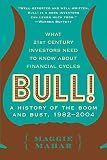
A History of the Boom and Bust, 19822004
by Maggie Mahar


Recommended by Nassim Nicholas Taleb and Warren Buffett
Check price on AmazonProof-backed recommendation
Amazon availability
See customer reviews on Amazon →Maggie Mahar writes with the pace and detail of a seasoned financial reporter, stitching together profiles, market moments, and policy shifts to tell the story of the 1982–early-2000s bull market. The book's useful part is a scene-by-scene view of how traders, executives, and regulators interacted over two decades, which makes the era's momentum concrete for readers who prefer character-driven financial history. Annoyances: long anecdotal stretches that repeat the same readings and a relative absence of deep charts or modern quantitative analysis, so technically focused readers may feel underserved.
This summary and audience guidance are AI-generated from the book's description and its recommendation history, last updated June 2026. Recommendations, quotes and sources elsewhere on this page come from published material and are not generated.
In 1982, the Dow hovered below 1000. Then, the market rose and rapidly gained speed until it peaked above 11,000. Noted journalist and financial reporter Maggie Mahar has written the first book on the remarkable bull market that began in 1982 and ended just in the early 2000s. For almost two decades, a colorful cast of characters such as Abby Josep...
Difficulty:easy
Check formats, pricing, and availability options for Kindle, physical print, or audiobooks directly.
View available editions on AmazonWhy recommended
Recommended by 4 sources and appears in Books Recommended by Warren Buffett, Most Recommended Books, and Finance.
People and public figures who have recommended this book.
Recommendation proof is sourced from public posts, interviews, reading lists, and cited references.
Nassim Nicholas Taleb
Author, essayist, mathematical statistician, and risk analyst
Recommended this book
Check formats, pricing, and availability options directly on Amazon.
Consider The Intelligent Investor by Benjamin Graham. Recommended by 23 sources.
“This is a slow, meticulous read that builds value investing principles through exhaustive stock comparisons and portfolio theory. The core useful insight is Graham’s emphasis on a margin of safety and treating market fluctuations as your servant, not your guide. The limitation: many examples hail from the 1940s-1970s, making the data feel irrelevant, and the prose can be pedantic, stretching patience. You'll get the timeless philosophy but must wade through antiquated case studies.”
Each recommendation is collected from a public source — interviews, articles, or curated lists — and linked to its original URL. Books with many verifiable recommendations from respected people rank higher.