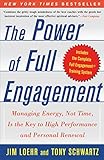
The Power of Full Engagement
Managing Energy, Not Time, Is the Key to High Performance and Personal Renewal
by Jim Loehr
3 more
More Recommenders
“It's not about how much time you have in your day but how you allocate you energy. | The authors worked with the best athletes and executives for years, and found that the best ones knew how to push themselves, then recuperate, push, recuperate. Take this same approach to your emotional, mental, physical, and even spiritual life, and it's a powerful metaphor. Think of sprints, not marathons. Be fully in whatever you're in, then give time to recuperate. But push futher each time, past your comfort zone, like a good exercise plan.”
Source →“It's not about how much time you have in your day but how you allocate you energy. | The authors worked with the best athletes and executives for years, and found that the best ones knew how to push themselves, then recuperate, push, recuperate. Take this same approach to your emotional, mental, physical, and even spiritual life, and it's a powerful metaphor. Think of sprints, not marathons. Be fully in whatever you're in, then give time to recuperate. But push futher each time, past your comfort zone, like a good exercise plan.”
Source →Recommended by 5 notable people, including Derek Sivers and Noah Kagan
Check price on AmazonProof-backed recommendation
Amazon availability
Reading Profile
Should I read this?
Voice alternates between blunt coach commands and earnest encouragement, delivering a clear organizing idea about balancing stress and recovery. Its most useful element is practical language and repeatable routines that make energy limitations feel negotiable during busy workweeks. Limitations: the same model gets re-stated in different contexts, and the tone can flip from no-nonsense to earnest in ways that some readers find grating. Best approached as a slow read with space to try one or two changes.
Read this if...
- •a mid-level project manager juggling overlapping deadlines and regular overtime, who needs practical routines and language to protect personal energy across a chaotic week
- •a startup founder running sprints through fundraising or product launches, looking for a disciplined way to alternate intense work blocks with deliberate recovery so burnout risk feels manageable
- •a team lead or coach responsible for keeping a group productive in crunch periods, who wants concrete habits and examples to model and teach stress/recovery practices
Skip this if...
- •you'll likely put it down when the core model and examples are restated chapter after chapter — repetition is a common dropout point
- •annoying if you prefer dense academic sourcing or long-form evidence citations; the tone favors practical instruction over scholarly apparatus
- •not a good fit if you only want quick hacks without mindset or habit change — the book asks for behavioral shifts rather than one-off tips
?Combines the gritty toughmindedness of the best coaches with the gentlebutinsistent inspiration of the most effective spiritual advisers? (Fast Company). This groundbreaking New York Times bestseller has helped hundreds of thousands of people at work and at home balance stress and recovery and sustain high performance despite crushing workloads ...
Before You Buy
Reading Specifications
Difficulty:hard
Audience Fit
- a mid-level project manager juggling overlapping deadlines and regular overtime, who needs practical routines and language to protect personal energy across a chaotic week
- a startup founder running sprints through fundraising or product launches, looking for a disciplined way to alternate intense work blocks with deliberate recovery so burnout risk feels manageable
- a team lead or coach responsible for keeping a group productive in crunch periods, who wants concrete habits and examples to model and teach stress/recovery practices
- you'll likely put it down when the core model and examples are restated chapter after chapter — repetition is a common dropout point
- annoying if you prefer dense academic sourcing or long-form evidence citations; the tone favors practical instruction over scholarly apparatus
- not a good fit if you only want quick hacks without mindset or habit change — the book asks for behavioral shifts rather than one-off tips
Check formats, pricing, and availability options for Kindle, physical print, or audiobooks directly.
View available editions on AmazonKey themes
Why recommended
Recommended by 6 sources and appears in Best Productivity Books, Entrepreneur, and Most Recommended Books.
Recommended by notable people
People and public figures who have recommended this book.
Recommendation Signals
Recommendation proof is sourced from public posts, interviews, reading lists, and cited references.
Scott Young
“It's not about how much time you have in your day but how you allocate you energy. | The authors worked with the best athletes and executives for years, and found that the best ones knew how to push themselves, then recuperate, push, recuperate. Take this same approach to your emotional, mental, physical, and even spiritual life, and it's a powerful metaphor. Think of sprints, not marathons. Be fully in whatever you're in, then give time to recuperate. But push futher each time, past your comfort zone, like a good exercise plan.”
View sources (3) ▾80%
Appears In

Not sure if this is the right fit?
Consider The Boy, the Mole, the Fox and the Horse by Charlie Mackesy. Recommended by 8 sources.
“Soft-spoken, heavily illustrated fable built from short dialogues and watercolor sketches. Each spread pairs a spare line of text with a loose drawing, so the pleasure is visual and aphoristic rather than narrative; readers collect felt-true sentences more than plot. Most useful when you want quick consolations, a prompt for conversation with a child, or a pause during a rough day. Limiting if you want sustained argument, concrete advice, or tightly plotted storytelling: the repetition of gentleness can feel sentimental or thin after a while.”
Similar books

The Boy, the Mole, the Fox and the Horse
Charlie Mackesy
The World as It Is
Ben Rhodes
Out of Control
Kevin Kelly
The Bully Pulpit
Doris Kearns Goodwin
The Seven Spiritual Laws of Success
Deepak Chopra
Billions and Billions
Carl Sagan
Anger
Gary ChapmanFactfulness
Hans RoslingHow recommendation signals are reviewed
Each recommendation is collected from a public source — interviews, articles, or curated lists — and linked to its original URL. Books with many verifiable recommendations from respected people rank higher.