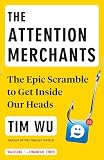
The Epic Scramble to Get Inside Our Heads
by Tim Wu
Recommended by Cleo Abram and Rafat Ali
Proof-backed recommendation
Amazon availability
Tim Wu follows the commercial history of attention from early advertising and broadcast radio to web-era tactics that prize constant engagement. The narrative stacks case studies and anecdotes into a single throughline: companies learned to capture, segment, and resell focus. The most useful part is the historical context that links familiar irritations—endless feeds, intrusive ads—to long commercial practices. The downside is a repetitive, occasionally polemical tone and a scarcity of practical remedies; readers looking for step-by-step fixes may feel frustrated.
This summary and audience guidance are AI-generated from the book's description and its recommendation history, last updated June 2026. Recommendations, quotes and sources elsewhere on this page come from published material and are not generated.
From Tim Wu, author of the awardwinning The Master Switch ( a New Yorker and Fortune Book of the Year) and who coined the term net neutralitya revelatory, ambitious and urgent account of how the capture and resale of human attention became the defining industry of our time. Feeling attention challenged Even assaulted American business depen...
Difficulty:hard
Check formats, pricing, and availability options for Kindle, physical print, or audiobooks directly.
View available editions on AmazonWhy recommended
Recommended by 5 sources and appears in Sociology, Most Recommended Books, and Technology.
People and public figures who have recommended this book.
Recommendation proof is sourced from public posts, interviews, reading lists, and cited references.
Cleo Abram
“Have to say @superwuster is best business writer there is. Just finished Master Switch , now reading “Attention Merchants”, the best historyincontextwithrigorandintellectualanalysis writer/explainer there is. If I ever write a book, want to write it like Tim Wu.”
Check formats, pricing, and availability options directly on Amazon.
Consider Outliers by Malcolm Gladwell. Recommended by 31 sources.
“Outliers reads like a series of captivating magazine profiles, each unpacking a hidden factor behind extraordinary success. Gladwell’s storytelling makes complex social science accessible, but the book relies on memorable anecdotes rather than offering systematic analysis. The book explores the idea that individual brilliance rarely stands alone; success often hinges on birth dates, cultural legacies, and the 10,000-hour rule. While the narratives are strong, the book overgeneralizes from handpicked examples, leaving skeptical readers questioning the conclusions. It’s most useful as a conversation starter about luck and timing—annoying if you want a rigorous academic treatise or a how-to guide for your own life.”

Each recommendation is collected from a public source — interviews, articles, or curated lists — and linked to its original URL. Books with many verifiable recommendations from respected people rank higher.