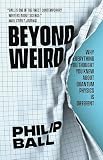
Why Everything You Thought You Knew about Quantum Physics Is Different
by Philip Ball
Philip Ball presents quantum mechanics as a set of conceptual puzzles that reach beyond the microscopic, favoring thought experiments and historical snapshots over equations. The writing aims to build intuition about probability, measurement, and entanglement without technical machinery. Most useful are the clear distinctions that help you question everyday assumptions about randomness and locality. Annoyances include repeated points and stretches of abstract argument that slow momentum for readers seeking experimental detail or concrete demonstrations.
This summary and audience guidance are AI-generated from the book's description and its recommendation history, last updated June 2026. Recommendations, quotes and sources elsewhere on this page come from published material and are not generated.
?Anyone who is not shocked by quantum theory has not understood it.?Since Niels Bohr said this many years ago, quantum mechanics has only been getting more shocking. We now realize that it?s not really telling us that ?weird? things happen out of sight, on the tiniest level, in the atomic world: rather, everything is quantum. But if quantum mechani...
Difficulty:hard
Check formats, pricing, and availability options for Kindle, physical print, or audiobooks directly.
View available editions on AmazonWhy recommended
appears in Physics and Physics.
Recommendation proof is sourced from public posts, interviews, reading lists, and cited references.
No verified recommendation proof available yet.
Check formats, pricing, and availability options directly on Amazon.
Consider Infinite Powers by Steven Strogatz. Recommended by 10 sources.
“Strogatz writes like an engaging guide who treats calculus as a human story: equations come with everyday analogies, historical side trips, and visual intuition. What works best is making why calculus matters—velocity, accumulation, and infinity—feel concrete without heavy formalism, so a reader finishes with better conceptual tools for understanding technology and science. The main limitation is pace: readers wanting rigorous proofs or a practice-based learning path will find it light and occasionally repetitive in examples and anecdotes.”
Each recommendation is collected from a public source — interviews, articles, or curated lists — and linked to its original URL. Books with many verifiable recommendations from respected people rank higher.