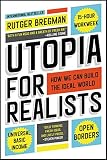
Utopia for Realists
How We Can Build the Ideal World
by Rutger Bregman
1 more
More Recommenders
“?Bismarck said politics is the art of the possible. In our time, though, politics has to be about making the impossible inevitable? ? paraphrased from Rutger Bregman?s inspiring book ?Utopia for realists?, p. 253 | „Bismarck said politics is the art of the possible. In our time, though, politics has to be about making the impossible inevitable“ — paraphrased from Rutger Bregman‘s inspiring book ‚Utopia for realists‘, p. 253”
Source →Recommended by 3 notable people, including Daniel Petre and Matej Latin
Check price on AmazonProof-backed recommendation
Amazon availability
Reading Profile
Should I read this?
Reading Utopia for Realists feels like sitting through a succession of energetic essays: historical vignettes, policy proposals, and moral provocations pushing for universal basic income, a 15-hour workweek, and fewer border barriers. Its useful part is clarity and imagination—it reframes familiar policy fights so you think bigger and argue differently. The main limitation is a reliance on broad examples and rhetorical force instead of deep technical detail; readers expecting exhaustive implementation plans or detailed cost modelling will find it thin.
Read this if...
- •a municipal policy analyst preparing a 20-minute briefing for city council next month about homelessness and income support—useful now because the book supplies short, memorable historical examples and reframing language you can use to expand the debate beyond immediate budget trade-offs
- •an HR director at a 200-person tech company facing rising turnover and burnout who needs to sell a 4-day/shorter-hours pilot to senior leadership—useful now because the book gives concise, debate-ready anecdotes and arguments to make the case for testing reduced hours with measurable outcomes
- •a grassroots campaign director running a local anti-poverty ballot initiative with limited ad budget—useful now because the book offers readable anecdotes and punchy framings that can be adapted into op-eds, talking points, and short social copy to persuade voters and local media
Skip this if...
- •you'll likely put it down when the book keeps restating big, hopeful examples without delivering step-by-step implementation or detailed numbers—if you want technical policy depth, this isn't it
- •annoying if you prefer data-heavy, sceptical analysis rather than narrative-driven persuasion and moral reasoning
- •annoying if you dislike sweeping idealism or confident prescriptions that downplay political friction; also lacks hands-on exercises or practical toolkits
From a universal basic income to a 15hour workweek, from a world without borders to a world without poverty ? it?s time to return to utopian thinking.Rutger Bregman takes us on a journey through history, beyond the traditional leftright divides, as he introduces ideas whose time has come. Utopia for Realists is one of those rare books that takes ...
Before You Buy
Reading Specifications
Difficulty:easy
Audience Fit
- a municipal policy analyst preparing a 20-minute briefing for city council next month about homelessness and income support—useful now because the book supplies short, memorable historical examples and reframing language you can use to expand the debate beyond immediate budget trade-offs
- an HR director at a 200-person tech company facing rising turnover and burnout who needs to sell a 4-day/shorter-hours pilot to senior leadership—useful now because the book gives concise, debate-ready anecdotes and arguments to make the case for testing reduced hours with measurable outcomes
- a grassroots campaign director running a local anti-poverty ballot initiative with limited ad budget—useful now because the book offers readable anecdotes and punchy framings that can be adapted into op-eds, talking points, and short social copy to persuade voters and local media
- you'll likely put it down when the book keeps restating big, hopeful examples without delivering step-by-step implementation or detailed numbers—if you want technical policy depth, this isn't it
- annoying if you prefer data-heavy, sceptical analysis rather than narrative-driven persuasion and moral reasoning
- annoying if you dislike sweeping idealism or confident prescriptions that downplay political friction; also lacks hands-on exercises or practical toolkits
Check formats, pricing, and availability options for Kindle, physical print, or audiobooks directly.
View available editions on AmazonKey themes
Why recommended
Recommended by 3 sources and appears in Sociology, Finance, and Politics.
Recommended by notable people
People and public figures who have recommended this book.
Recommendation Signals
Recommendation proof is sourced from public posts, interviews, reading lists, and cited references.
Matej Latin
“?Bismarck said politics is the art of the possible. In our time, though, politics has to be about making the impossible inevitable? ? paraphrased from Rutger Bregman?s inspiring book ?Utopia for realists?, p. 253 | „Bismarck said politics is the art of the possible. In our time, though, politics has to be about making the impossible inevitable“ — paraphrased from Rutger Bregman‘s inspiring book ‚Utopia for realists‘, p. 253”
Appears In
Not sure if this is the right fit?
Consider Outliers by Malcolm Gladwell. Recommended by 31 sources.
“Outliers reads like a series of captivating magazine profiles, each unpacking a hidden factor behind extraordinary success. Gladwell’s storytelling makes complex social science accessible, but the book relies on memorable anecdotes rather than offering systematic analysis. The book explores the idea that individual brilliance rarely stands alone; success often hinges on birth dates, cultural legacies, and the 10,000-hour rule. While the narratives are strong, the book overgeneralizes from handpicked examples, leaving skeptical readers questioning the conclusions. It’s most useful as a conversation starter about luck and timing—annoying if you want a rigorous academic treatise or a how-to guide for your own life.”
Similar books
How recommendation signals are reviewed
Each recommendation is collected from a public source — interviews, articles, or curated lists — and linked to its original URL. Books with many verifiable recommendations from respected people rank higher.