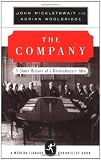
The Company
A Short History of a Revolutionary Idea (Modern Library Chronicles)
by John Micklethwait
2 more
More Recommenders
“@natemodi @avichal @GoodTimeShowCH Fantastic book. I think @cdixon first recommended it to me | @natemodi @sriramk @avichal @GoodTimeShowCH Yes! best book about DAOs :) | Here are the blocks for today's episode with @cdixon The original Bitcoin white paper is a fascinating read, as is the book "The Company"”
Source →“@natemodi @avichal @GoodTimeShowCH Fantastic book. I think @cdixon first recommended it to me | @natemodi @sriramk @avichal @GoodTimeShowCH Yes! best book about DAOs :) | Here are the blocks for today's episode with @cdixon The original Bitcoin white paper is a fascinating read, as is the book "The Company"”
Source →Recommended by 4 notable people, including Paul Graham and Patrick O'Shaughnessy
Check price on AmazonProof-backed recommendation
Amazon availability
Reading Profile
Should I read this?
Reading The Company feels like a brisk sweep through modern economic history anchored by the claim that the corporation, not the state or party, is the basic unit of modern society. Micklethwait traces corporate origins, growth, and global spread with illustrative episodes and policy-minded takeaways; the useful part is a broad timeline tying historical moments to today's corporate roles. Limitation: the tone favors broad interpretation over deep, case-by-case evidence, so readers wanting granular data or skeptical counterarguments may find it thin. Prose reads like brisk magazine reporting, not deep academic treatment.
Read this if...
- •an in-house communications lead crafting a corporate-purpose talk — wants historical talking points to place the company in a wider social story
- •an MBA student preparing for a seminar on business history — needs a readable timeline and cross-national examples to frame discussion
- •a policy analyst writing background briefs on corporate evolution — wants a narrative sense of how corporate forms spread and interacted with institutions
Skip this if...
- •you'll likely put it down when the narrative repeats the central claim without new evidence — tedious if you wanted tightly sourced case studies
- •annoying if you prefer prescriptive, hands-on management advice or step-by-step implementation — this is descriptive and historical, not a how-to
- •you'll lose interest if a pro-company tilt or upbeat institutional framing makes you want stronger critique of corporate harms and power imbalances
Chosen by BusinessWeek as One of the Top Ten Business Books of the Year With apologies to Hegel, Marx, and Lenin, the basic unit of modern society is neither the state, nor the commune, nor the party; it is the company. From this bold premise, John Micklethwait and Adrian Wooldridge chart the rise of one of history’s great catalysts for good and ev...
Before You Buy
Reading Specifications
Difficulty:easy
Audience Fit
- an in-house communications lead crafting a corporate-purpose talk — wants historical talking points to place the company in a wider social story
- an MBA student preparing for a seminar on business history — needs a readable timeline and cross-national examples to frame discussion
- a policy analyst writing background briefs on corporate evolution — wants a narrative sense of how corporate forms spread and interacted with institutions
- you'll likely put it down when the narrative repeats the central claim without new evidence — tedious if you wanted tightly sourced case studies
- annoying if you prefer prescriptive, hands-on management advice or step-by-step implementation — this is descriptive and historical, not a how-to
- you'll lose interest if a pro-company tilt or upbeat institutional framing makes you want stronger critique of corporate harms and power imbalances
Check formats, pricing, and availability options for Kindle, physical print, or audiobooks directly.
View available editions on AmazonKey themes
Why recommended
Recommended by 4 sources and appears in Books Recommended by Paul Graham, Finance, and Business.
Recommended by notable people
People and public figures who have recommended this book.
Recommendation Signals
Recommendation proof is sourced from public posts, interviews, reading lists, and cited references.

Paul Graham
Co-founder of Y Combinator; essayist
“@natemodi @avichal @GoodTimeShowCH Fantastic book. I think @cdixon first recommended it to me | @natemodi @sriramk @avichal @GoodTimeShowCH Yes! best book about DAOs :) | Here are the blocks for today's episode with @cdixon The original Bitcoin white paper is a fascinating read, as is the book "The Company"”
View sources (3) ▾80%
Appears In
Not sure if this is the right fit?
Consider The Undoing Project by Michael Lewis. Recommended by 18 sources.
“Michael Lewis chronicles the friendship and intellectual partnership of Daniel Kahneman and Amos Tversky, who championed the idea that cognitive biases shape our choices. The narrative reads like a buddy story, weaving their discoveries into personal anecdotes and the drama of their collaboration. You'll grasp key ideas—loss aversion, framing—through their story, but the book focuses on biography, not application. Helpful for understanding behavioral economics' origins; less useful if you want actionable advice. The emotional arc of their relationship can overshadow the science.”
Similar books
The Undoing Project
Michael Lewis
The Little Book of Common Sense Investing
John C. Bogle
Financial Shenanigans
Howard Schilit
Scale
Geoffrey West
Poor Numbers
Morten Jerven
The Great Illusion
Norman Angell
One Billion Americans
Matthew Yglesias
Accounting Principles Standalone book
Jerry J. WeygandtHow recommendation signals are reviewed
Each recommendation is collected from a public source — interviews, articles, or curated lists — and linked to its original URL. Books with many verifiable recommendations from respected people rank higher.