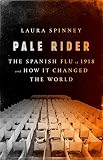
Pale Rider
The Spanish Flu of 1918 and How It Changed the World
by Laura Spinney
Recommended by Balaji S. Srinivasan and Daniel W. Drezner
Check price on AmazonProof-backed recommendation
Amazon availability
Reading Profile
Should I read this?
The book reconstructs the 1918–20 influenza through globe-trotting reporting and local vignettes, turning vast death counts into human scenes from Alaska to Brazil. The book's strength lies in granular, place-based portraits and archival detail that argue wartime conditions and local culture shaped responses. The narrative slows in a middle stretch where comparable case studies and technical detours accumulate, dulling momentum. Expect texture and narrative atmosphere rather than compact timelines or step-by-step lessons.
Read this if...
- •high-school history teacher planning a unit on early 20th-century crises who needs vivid, classroom-ready anecdotes from different countries to spark discussion; the book presents human-scale scenes to make abstract numbers tangible.
- •public-health master's student assembling qualitative context for a paper on pandemic response patterns and policy differences; the book's cross-regional reporting helps illustrate contrasting social reactions and local constraints.
- •commuter or traveler who reads in 30–90 minute blocks and prefers vignette-driven nonfiction to carry attention between stops; the book's chapter-sized portraits make it easy to pause and pick up again.
Skip this if...
- •You'll likely put it down when the middle chapters repeat similar local case studies and technical digressions — that midsection is where momentum stalls.
- •Annoying if you prefer concise, numbers-first timelines and tight causal argumentation rather than atmospheric, anecdote-heavy prose.
- •Not for readers seeking prescriptive takeaways or hands-on guidance — the book lacks exercises or step-by-step recommendations and stays narratively focused.
With a death toll between fifty and one hundred million people across the globe, the Spanish flu of 19181920 was one of the greatest human disasters of all time. Nevertheless, it exists in our memory as a mere footnote to World War IIn Pale Rider, Laura Spinney recounts the story of this overlooked pandemic, tracing it from Alaska to Brazil, from ...
Before You Buy
Reading Specifications
Difficulty:hard
Audience Fit
- high-school history teacher planning a unit on early 20th-century crises who needs vivid, classroom-ready anecdotes from different countries to spark discussion; the book presents human-scale scenes to make abstract numbers tangible.
- public-health master's student assembling qualitative context for a paper on pandemic response patterns and policy differences; the book's cross-regional reporting helps illustrate contrasting social reactions and local constraints.
- commuter or traveler who reads in 30–90 minute blocks and prefers vignette-driven nonfiction to carry attention between stops; the book's chapter-sized portraits make it easy to pause and pick up again.
- You'll likely put it down when the middle chapters repeat similar local case studies and technical digressions — that midsection is where momentum stalls.
- Annoying if you prefer concise, numbers-first timelines and tight causal argumentation rather than atmospheric, anecdote-heavy prose.
- Not for readers seeking prescriptive takeaways or hands-on guidance — the book lacks exercises or step-by-step recommendations and stays narratively focused.
Check formats, pricing, and availability options for Kindle, physical print, or audiobooks directly.
View available editions on AmazonKey themes
Why recommended
Recommended by 3 sources and appears in Infectious Diseases and Most Recommended Books.
Recommended by notable people
People and public figures who have recommended this book.
Recommendation Signals
Recommendation proof is sourced from public posts, interviews, reading lists, and cited references.
Daniel W. Drezner
“@AndrewMLeber @profmusgrave @BeijingPalmer That?s a great book (I?m pretty sure it?s cited in the IO piece).”
Appears In

Not sure if this is the right fit?
Consider 11/22/63 by Stephen King. Recommended by 4 sources.
“Starts as a lean, suspenseful time-travel premise that quickly settles into an immersive, character-focused saga. Its chief useful part is the way everyday 1960s small-town life and personal relationships make the historical stakes feel immediate; the novel rewards readers who relish atmosphere and slow moral puzzles. The main limitation is length and digressions—long domestic passages and episodic subplots stretch the middle and can undercut urgency for readers who wanted a tighter thriller.”
Similar books

11/22/63
Stephen KingGuns, Germs, and Steel
Jared Diamond12 Rules for Life
Jordan Peterson21 Lessons for the 21st Century
Yuval Noah Harari
Polio
David M. Oshinsky
100 Endgames You Must Know
Jesus de la VillaA Planet of Viruses
Carl ZimmerThe Great Influenza
John M. BarryHow recommendation signals are reviewed
Each recommendation is collected from a public source — interviews, articles, or curated lists — and linked to its original URL. Books with many verifiable recommendations from respected people rank higher.