BookMentionsBookMentions
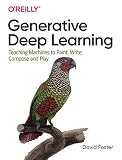
Generative Deep Learning

Generative Deep Learning

Teaching Machines to Paint, Write, Compose, and Play

by David Foster

Check price on Amazon

Proof-backed recommendation

Amazon availability

Reading Profile

Difficulty:hard
Themes:intuition vs maththeory vs implementation

Should I read this?

Generative Deep Learning delivers hands-on, code-centered walkthroughs of contemporary generative architectures, pairing conceptual intuition with runnable examples you can adapt. The most useful pages translate model descriptions into experiments and implementation tips, with attention to limitations around training and sampling. The limiting side is density: extended code listings, environment/setup detail, and engineering commentary slow the pace and repeat themes. Readers after social, ethical, or policy context will find those topics only lightly sketched.

Read this if...

  • a graduate student building a semester project in generative models who needs runnable code and pragmatic implementation notes to finish experiments on schedule
  • a machine-learning engineer at a startup prototyping image or music generation features who wants concrete trade-offs and code patterns to move from idea to prototype
  • a data scientist shifting from discriminative models to generative methods who prefers executable experiments to watch sampling behavior and debug model outputs

Skip this if...

  • you'll likely put it down when chapters switch into extended code listings, environment setup, and implementation minutiae — that technical slog is a common drop-off point
  • annoying if you prefer books that focus on social, ethical, or policy implications rather than engineering detail and recipes
  • not for readers without programming and linear-algebra fluency — the material assumes technical background and can feel inaccessible otherwise

Generative modeling is one of the hottest topics in Artificial Intelligence,. Recent advances in the field have shown how it's possible to teach a machine to excel at human endeavorssuch as drawing, composing music, and completing tasksby generating an understanding of how its actions affect its environment.With this practical book, machine lear...

Before You Buy

Reading Specifications

Difficulty:hard

Themes:
intuition vs maththeory vs implementationcreative output vs statistical limits

Audience Fit

Recommended for:
  • a graduate student building a semester project in generative models who needs runnable code and pragmatic implementation notes to finish experiments on schedule
  • a machine-learning engineer at a startup prototyping image or music generation features who wants concrete trade-offs and code patterns to move from idea to prototype
  • a data scientist shifting from discriminative models to generative methods who prefers executable experiments to watch sampling behavior and debug model outputs
Not ideal if you want:
  • you'll likely put it down when chapters switch into extended code listings, environment setup, and implementation minutiae — that technical slog is a common drop-off point
  • annoying if you prefer books that focus on social, ethical, or policy implications rather than engineering detail and recipes
  • not for readers without programming and linear-algebra fluency — the material assumes technical background and can feel inaccessible otherwise

Check formats, pricing, and availability options for Kindle, physical print, or audiobooks directly.

View available editions on Amazon

Key themes

intuition vs maththeory vs implementationcreative output vs statistical limitscompute cost vs model qualityexperimentation vs interpretability

Why recommended

appears in Machine Learning and Data Science.

Recommendation Signals

Recommendation proof is sourced from public posts, interviews, reading lists, and cited references.

No verified recommendation proof available yet.

Appears In

Life 3.0
Try This Instead

Not sure if this is the right fit?

Consider Life 3.0 by Max Tegmark. Recommended by 18 sources.

Life 3.0 reads like a long, wide-ranging conversation with a physicist who loves big if-then thought experiments. The useful part is its panoramic sweep across possible AI futures—from job automation to cosmic colonization—forcing you to consider timelines you might otherwise avoid. The limitation is that the speculative breadth often outruns the depth; chapters can feel meandering, and some readers will find the cosmic-scale scenarios too detached from practical concerns, making it hard to ground in real urgency.

Similar books

How recommendation signals are reviewed

Each recommendation is collected from a public source — interviews, articles, or curated lists — and linked to its original URL. Books with many verifiable recommendations from respected people rank higher.

Generative Deep Learning

Generative Deep Learning

View on Amazon →