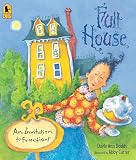
An Invitation to Fractions
by Dayle Ann Dodds
Full House by Dayle Ann Dodds is a bright, sing-song picture book set in the Strawberry Inn where guests arrive until every room is full; the rhyming text and busy, whimsical art make it an easy read-aloud that nudges toward simple fraction ideas through counting and sharing. Its useful part is creating a playful, memorable frame for introducing halves and quarters without heavy exposition. Limitation: math remains implicit and adults looking for precise teaching language or practice prompts will find it thin.
This summary and audience guidance are AI-generated from the book's description and its recommendation history, last updated June 2026. Recommendations, quotes and sources elsewhere on this page come from published material and are not generated.
"Fresh, whimsical illustrations fairly float off the pages. Rhyming text invites readers. . . . A fun choice for reinforcing the concept of fractions." School Library JournalMiss Bloom runs the Strawberry Inn, and she loves visitors. All through the day she welcomes a cast of hilarious characters until all the rooms are taken. It's a full house!...
Difficulty:hard
Check formats, pricing, and availability options for Kindle, physical print, or audiobooks directly.
View available editions on AmazonWhy recommended
appears in Math and Math Science.
Recommendation proof is sourced from public posts, interviews, reading lists, and cited references.
No verified recommendation proof available yet.
Check formats, pricing, and availability options directly on Amazon.
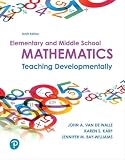
Consider Elementary and Middle School Mathematics by John A. van de Walle.
“Elementary and Middle School Mathematics functions as a practical classroom reference for PreK–8 teachers, with sustained attention to how children develop number sense and mathematical thinking. Most useful are the staged descriptions of learning progressions and concrete examples for adapting tasks to different ages and ability levels. The limitation is that the book offers more explanation than finished materials—expect to turn principles into activities yourself. The writing can be detailed and repetitive at times, so it rewards focused, topic-by-topic reading rather than quick skimming.”
Each recommendation is collected from a public source — interviews, articles, or curated lists — and linked to its original URL. Books with many verifiable recommendations from respected people rank higher.