BookMentionsBookMentions
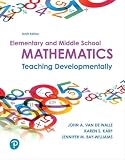
Elementary and Middle School Mathematics

Elementary and Middle School Mathematics

Teaching Developmentally (10th Edition)

by John A. van de Walle

Check price on Amazon

Proof-backed recommendation

Amazon availability

Reading Profile

Difficulty:hard
Themes:concrete models vs symbolic proceduresdevelopmental progression vs grade-level pacing

Should I read this?

Elementary and Middle School Mathematics functions as a practical classroom reference for PreK–8 teachers, with sustained attention to how children develop number sense and mathematical thinking. Most useful are the staged descriptions of learning progressions and concrete examples for adapting tasks to different ages and ability levels. The limitation is that the book offers more explanation than finished materials—expect to turn principles into activities yourself. The writing can be detailed and repetitive at times, so it rewards focused, topic-by-topic reading rather than quick skimming.

Read this if...

  • an elementary teacher switching grade levels who needs a compact, developmentally-grounded overview of what to emphasize this year and how to adjust previous lessons for a new age group
  • a special education teacher covering multiple grades who needs practical staging ideas and differentiation strategies to scaffold the same concept across varied ability levels
  • a K–8 curriculum coordinator updating scope-and-sequence who wants clear descriptions of developmental progressions to inform pacing decisions and alignment discussions with teachers

Skip this if...

  • you'll likely put it down when chapters shift into dense, explanatory prose without quick takeaways or ready-made activities
  • annoying if you prefer ready-to-run, printable lesson plans or activity sheets—this is not a packet of turnkey materials and lacks hands-on exercises
  • not for readers after a breezy, anecdote-driven read: the tone can feel clinical and procedural rather than conversational

This handy reference is particularly useful for elementary teachers who are changing grade levels and special education teachers who teach multiple grades and multiple ability levels. Guide teachers to help all PreK8 learners make sense of mathematics Elementary and Middle School Mathematics: Teaching Developmentally illustrates how children learn...

Before You Buy

Reading Specifications

Difficulty:hard

Themes:
concrete models vs symbolic proceduresdevelopmental progression vs grade-level pacingdifferentiation vs whole-class delivery

Audience Fit

Recommended for:
  • an elementary teacher switching grade levels who needs a compact, developmentally-grounded overview of what to emphasize this year and how to adjust previous lessons for a new age group
  • a special education teacher covering multiple grades who needs practical staging ideas and differentiation strategies to scaffold the same concept across varied ability levels
  • a K–8 curriculum coordinator updating scope-and-sequence who wants clear descriptions of developmental progressions to inform pacing decisions and alignment discussions with teachers
Not ideal if you want:
  • you'll likely put it down when chapters shift into dense, explanatory prose without quick takeaways or ready-made activities
  • annoying if you prefer ready-to-run, printable lesson plans or activity sheets—this is not a packet of turnkey materials and lacks hands-on exercises
  • not for readers after a breezy, anecdote-driven read: the tone can feel clinical and procedural rather than conversational

Check formats, pricing, and availability options for Kindle, physical print, or audiobooks directly.

View available editions on Amazon

Key themes

concrete models vs symbolic proceduresdevelopmental progression vs grade-level pacingdifferentiation vs whole-class deliveryconceptual understanding vs procedural fluencyassessment-for-instruction vs standards-checking

Why recommended

appears in Math.

Recommendation Signals

Recommendation proof is sourced from public posts, interviews, reading lists, and cited references.

No verified recommendation proof available yet.

Appears In

365 Penguins
Try This Instead

Not sure if this is the right fit?

Consider 365 Penguins by JeanLuc Fromental.

Bright, repetitive, and slyly absurd, 365 Penguins turns a simple counting premise into a steady comedic escalation: each day's added bird raises practical problems until the family's house—and patience—begin to creak. Best value is as a read-aloud or classroom counting prompt: kids can shout numbers, predict outcomes, and laugh at increasingly baroque solutions. Limitation: the repetition is deliberate but prolonged, and adults wanting narrative depth or varied pacing may find it wearing; character development is minimal and consequences stay light.

Similar books

How recommendation signals are reviewed

Each recommendation is collected from a public source — interviews, articles, or curated lists — and linked to its original URL. Books with many verifiable recommendations from respected people rank higher.

Elementary and Middle School Mathematics

Elementary and Middle School Mathematics

View on Amazon →