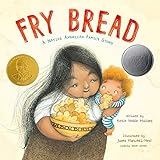
Fry Bread
A Native American Family Story
by Kevin Noble Maillard
Reading Profile
Should I read this?
Warm, sensory prose and celebratory lines make this a natural read-aloud about fry bread as food, memory, and community. The book’s most useful angle is its ability to link a single shared food to family rituals and national belonging in a few lyrical pages. Limiting moments come from very spare text and a refrain-driven structure: readers looking for a plot arc, in-depth history, or practical recipes will find the pacing repetitive and the context light.
Read this if...
- •a parent of a preschooler seeking a 5–10 minute bedtime read that introduces cultural food and family traditions through sensory language and repetition
- •an elementary teacher planning a short multicultural storytime where the goal is to prompt discussion about traditions and shared meals rather than deliver historical detail
- •a children’s librarian assembling a community storytime centered on food, celebration, or belonging who needs a visually strong, chant-like title to read aloud
Skip this if...
- •you’ll likely put it down when you realize the text is deliberately spare and refrain-heavy — disappointing if you wanted a plot-driven picture book
- •annoying if you prefer nonfiction context or recipes, since the book emphasizes feeling and ritual over practical or historical detail
- •lose interest if you expect varied pacing; repetitive lines and short meditative pages can feel slow or thin if you want action or character development
Fry bread is food.It is warm and delicious, piled high on a plate.Fry bread is time.It brings families together for meals and new memories.Fry bread is nation.It is shared by many, from coast to coast and beyond.Fry bread is us.It is a celebration of old and new, traditional and modern, similarity and difference....
Before You Buy
Reading Specifications
Difficulty:hard
Audience Fit
- a parent of a preschooler seeking a 5–10 minute bedtime read that introduces cultural food and family traditions through sensory language and repetition
- an elementary teacher planning a short multicultural storytime where the goal is to prompt discussion about traditions and shared meals rather than deliver historical detail
- a children’s librarian assembling a community storytime centered on food, celebration, or belonging who needs a visually strong, chant-like title to read aloud
- you’ll likely put it down when you realize the text is deliberately spare and refrain-heavy — disappointing if you wanted a plot-driven picture book
- annoying if you prefer nonfiction context or recipes, since the book emphasizes feeling and ritual over practical or historical detail
- lose interest if you expect varied pacing; repetitive lines and short meditative pages can feel slow or thin if you want action or character development
Check formats, pricing, and availability options for Kindle, physical print, or audiobooks directly.
View available editions on AmazonKey themes
Why recommended
appears in Native American, Food, and Fiction.
Recommendation Signals
Recommendation proof is sourced from public posts, interviews, reading lists, and cited references.
No verified recommendation proof available yet.
Appears In
Not sure if this is the right fit?
Consider The Republic by Plato. Recommended by 13 sources.
“Plato stages an extended Socratic conversation that moves from concrete questions about justice into broad proposals about an ideal city, the structure of the soul, and what counts as reality and knowledge. Reading alternates brisk question-and-answer snippets with long, cumulative demonstrations that reward careful attention and annotation. Main value: a wealth of thought experiments for testing political and ethical intuitions. Main limitation: repetitive refutations, long policy sketches and dense metaphysical passages can feel abstruse and slow; patience and some philosophical background help.”
Similar books
How recommendation signals are reviewed
Each recommendation is collected from a public source — interviews, articles, or curated lists — and linked to its original URL. Books with many verifiable recommendations from respected people rank higher.