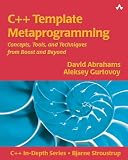
C Template MetaProgramming,
by David Abrahams
Reading Profile
Should I read this?
Expect a dense, code-first manual that forces you to think of C++ types as executable pieces of logic. Main value: it turns template syntax into reusable compile-time techniques through many worked examples and concrete implementations. Main limitation: the book assumes strong prior knowledge of C++ templates and spends little time on gentle introductions or modern standard shortcuts, so newcomers or readers seeking hand-holding will struggle. Best read with a compiler on hand so you can run and tinker with the examples.
Read this if...
- •senior C++ library author who’s been asked to refactor a public API to reduce runtime overhead while keeping backwards behavior — right now you need concrete, implementation-level patterns for zero-overhead abstractions and clear examples of template-based techniques.
- •systems programmer operating a latency-sensitive service (network stack, trading engine, or realtime pipeline) who must shave micro- or nanoseconds off hot paths — right now you want specific compile-time strategies to move work out of runtime and to validate those techniques with real code.
- •graduate student or embedded engineer prototyping an embedded DSL or metaprogramming-heavy component for constrained devices who must prove ideas under tight CPU/memory budgets — right now you need worked examples and implementation recipes to iterate and convince teammates.
Skip this if...
- •annoying if you prefer modern-standard shortcuts and brief examples — the text expects you to wrestle with long template code.
- •you'll likely put it down when pages of nested angle-bracket templates accumulate and the prose assumes earlier patterns without re-explaining them.
- •not suitable if you want guided practice or exercises — the book lacks hands-on exercises and structured drills for novices.
Abrahams and Gurtovoy have written something close to a classic... marvelous fun to read... Read the complete book review by Jack J. Woehr, Dr. Dobbs Journal, June 03, 2005 "If you're like me, you're excited by what people do with template metaProgramming, (TMP) but are frustrated at the lack of clear guidance and powerful tools. Well, this is the b...
Before You Buy
Reading Specifications
Difficulty:hard
Audience Fit
- senior C++ library author who’s been asked to refactor a public API to reduce runtime overhead while keeping backwards behavior — right now you need concrete, implementation-level patterns for zero-overhead abstractions and clear examples of template-based techniques.
- systems programmer operating a latency-sensitive service (network stack, trading engine, or realtime pipeline) who must shave micro- or nanoseconds off hot paths — right now you want specific compile-time strategies to move work out of runtime and to validate those techniques with real code.
- graduate student or embedded engineer prototyping an embedded DSL or metaprogramming-heavy component for constrained devices who must prove ideas under tight CPU/memory budgets — right now you need worked examples and implementation recipes to iterate and convince teammates.
- annoying if you prefer modern-standard shortcuts and brief examples — the text expects you to wrestle with long template code.
- you'll likely put it down when pages of nested angle-bracket templates accumulate and the prose assumes earlier patterns without re-explaining them.
- not suitable if you want guided practice or exercises — the book lacks hands-on exercises and structured drills for novices.
Check formats, pricing, and availability options for Kindle, physical print, or audiobooks directly.
View available editions on AmazonKey themes
Why recommended
appears in C Plus Plus, Programming, and Technology.
Recommendation Signals
Recommendation proof is sourced from public posts, interviews, reading lists, and cited references.
No verified recommendation proof available yet.
Appears In

Not sure if this is the right fit?
Consider Dealers of Lightning by Michael A. Hiltzik. Recommended by 8 sources.
“Starts as a vivid inventory of inventors, projects, and lab culture at Xerox PARC, written in reporterly detail that foregrounds anecdotes and corporate memos. Main value is a textured sense of how early GUI, networking, and printing research happened and how personalities and management decisions shaped outcomes. Limitation: the narrative can dwell on minutiae and internal politics, slowing forward momentum and offering few clear takeaways for readers seeking practical lessons or modern startup playbooks. It reads like sustained magazine reporting, so detail-oriented readers are rewarded while those after a brisk how-to may be frustrated.”
Similar books

Dealers of Lightning
Michael A. Hiltzik
Adaptive Code via C#
Gary McLean
JavaScript
David Flanagan
Artificial Intelligence,
Stuart Russell
Patterns of Enterprise Application Architecture,
Martin Fowler
Absolute Beginner's Guide to C
Greg Perry
Beginning C Through Game Programming,
Michael Dawson
Algorithms Unlocked
Thomas H. CormenHow recommendation signals are reviewed
Each recommendation is collected from a public source — interviews, articles, or curated lists — and linked to its original URL. Books with many verifiable recommendations from respected people rank higher.