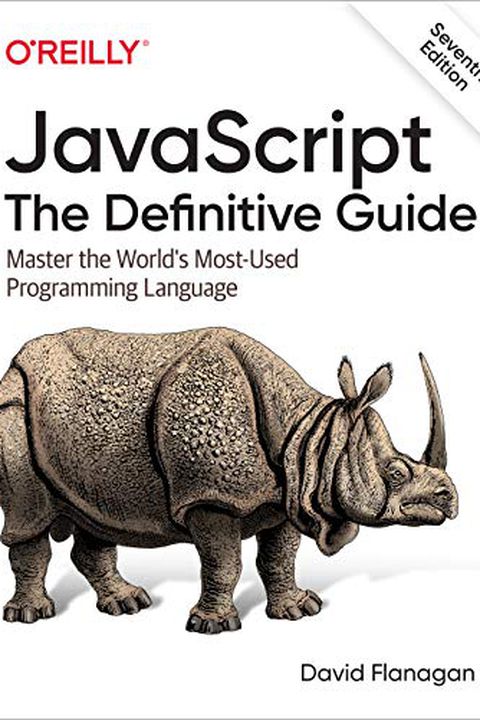
The Definitive Guide
by David Flanagan
Flanagan's JavaScript reads like a careful language manual: early chapters lay out syntax and ES2017 features with clear examples, mid sections shift into dense API catalogues and cross-browser edge cases, and later parts serve as reference pages you return to. Useful when you need precise behavior explanations and concrete code snippets during debugging or refactoring; annoying when you wanted a project-driven tutorial, because the tone becomes detail-heavy and repetitious and the middle can feel like slogging through tables. Best used in short consults rather than a single marathon read.
This summary and audience guidance are AI-generated from the book's description and its recommendation history, last updated May 2026. Recommendations, quotes and sources elsewhere on this page come from published material and are not generated.
For web developers and other programmers interested in using JavaScript, this bestselling book provides the most comprehensive JavaScript reference section on the market. The seventh edition represents a significant update, with new material for ECMAScript 2017 (ES8), and new chapters on languagespecific features.JavaScript: The Definitive Guide i...
Difficulty:easy
Check formats, pricing, and availability options for Kindle, physical print, or audiobooks directly.
View available editions on AmazonWhy recommended
appears in Programming, Technology, and Nonfiction.
Recommendation proof is sourced from public posts, interviews, reading lists, and cited references.
No verified recommendation proof available yet.
Check formats, pricing, and availability options directly on Amazon.
Consider Accidental Presidents by Jared Cohen. Recommended by 10 sources.
“Accidental Presidents offers eight narrative portraits of men who succeeded to the U.S. presidency without election, using anecdote-rich scenes and readable context to show how personality and circumstance interact with office power. It’s strongest as a set of self-contained stories that make succession stakes concrete for non-specialist readers; it does not prioritize dense archival argument or exhaustive methodology, so expect some interpretive generalizations and repeated themes across cases. Use it for fast historical orientation rather than scholarly deep-dives.”

Each recommendation is collected from a public source — interviews, articles, or curated lists — and linked to its original URL. Books with many verifiable recommendations from respected people rank higher.