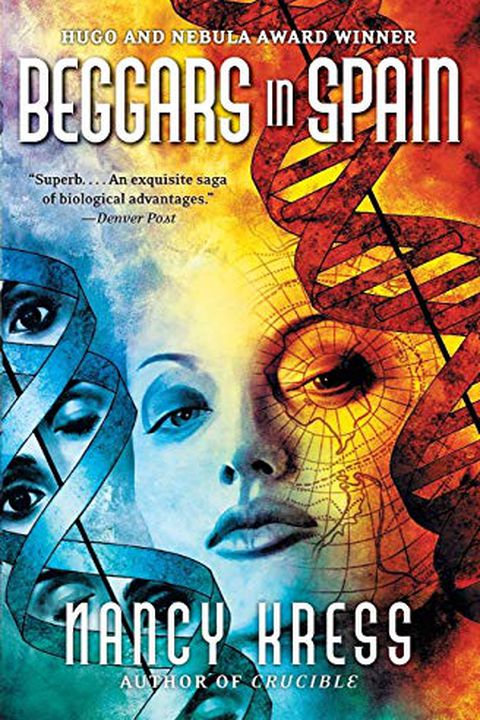
by Nancy Kress
Begins as an intimate sibling drama—one twin engineered never to need sleep, the other a control—and then widens into social and legal consequences as a growing class of 'Sleepless' reshapes work and education. Its value lies in putting policy limitations into repeated human-scale scenes rather than abstract hypotheticals. Limitation: substantial stretches feel argument-heavy and schematic, with exposition and courtroom-style sequences that slow pacing and sometimes flatten emotional subtlety for readers seeking brisk plot or nuanced character interiority.
This summary and audience guidance are AI-generated from the book's description and its recommendation history, last updated May 2026. Recommendations, quotes and sources elsewhere on this page come from published material and are not generated.
In this future, some people need no sleep at all. Leisha Camden was genetically modified at birth to require no sleep, and her normal twin Alice is the control. Problems and envy between the sisters mirror those in the larger world, as society struggles to adjust to a growing pool of people who not only have 30 percent more time to work and study t...
Difficulty:hard
Check formats, pricing, and availability options for Kindle, physical print, or audiobooks directly.
View available editions on AmazonWhy recommended
appears in Science Fiction, Science Fiction, and Science.
Recommendation proof is sourced from public posts, interviews, reading lists, and cited references.
No verified recommendation proof available yet.
Check formats, pricing, and availability options directly on Amazon.
Consider The Three-Body Problem by Cixin Liu. Recommended by 24 sources.
“This novel starts as a mystery rooted in a woman’s tragic experience during China’s Cultural Revolution, then spirals into a high-concept alien contact story built on intricate physics and game theory. The useful part lies in its audacious imagination: a three-body solar system, a virtual reality game, and a shocking revelation about humanity’s place in the universe. The limiting part may be its cold, analytical style and flat characters; emotion takes a backseat to ideas, and the scientific digressions can feel like lectures. It’s a slow burn that rewards intellectual curiosity but might alienate those craving warmth or narrative immediacy.”
Each recommendation is collected from a public source — interviews, articles, or curated lists — and linked to its original URL. Books with many verifiable recommendations from respected people rank higher.