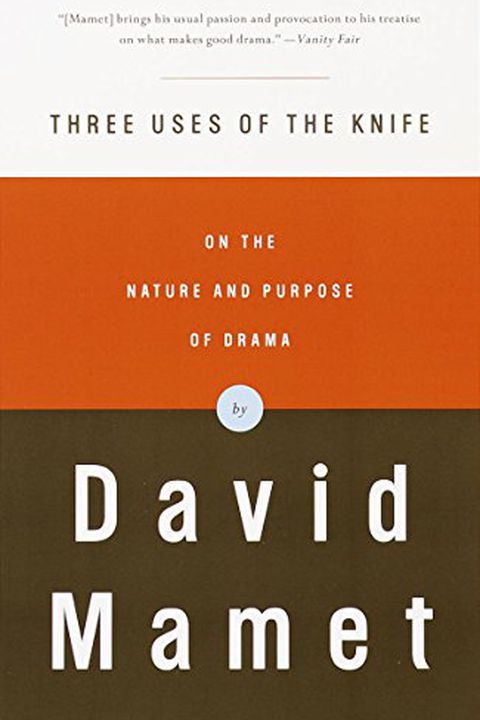
Three Uses of the Knife
On the Nature and Purpose of Drama
by David Mamet
Reading Profile
Should I read this?
Three Uses of the Knife reads like a series of bracing, aphoristic essays where David Mamet argues that theater—like magic and religion—is meant to do something more than entertain: it should produce cleansing awe. The value is the bluntness and the density of the claims, which can spark fresh thinking about what drama is for. The limitation is that the certainty can feel preachy or repetitive, and readers looking for technique or craft exercises may feel stalled.
Read this if...
- •A working screenwriter doing a rewrite on a scene that “works” on paper but feels empty, because the book’s purpose-first angle gives you a quick way to interrogate what the scene is trying to accomplish beyond plot mechanics.
- •A theater subscriber who’s burned out by endless, content-like productions and wants a firm argument for why drama still has a special job, because the book frames performance as a ritual act with a goal that’s larger than entertainment.
- •A university student in a film/theater class arguing with classmates about what counts as “good writing,” because the book’s quotable, direct propositions make it easy to start debates and push back on other definitions of craft.
Skip this if...
- •You’ll likely put it down when you realize you’re not getting craft instructions or step-by-step writing guidance, since the focus is on art’s purpose and attitudes, not technique.
- •You may lose patience if you want nuanced, balanced discussion instead of confident, sometimes combative claims, because the voice leans into authority and sharp judgments.
- •You’ll struggle past the midpoint if you prefer varied examples and detailed walkthroughs, since the argument can feel restated in different guises and grow tedious.
The purpose of theater, like magic like religion? is to inspire cleansing awe. With bracing directness and aphoristic authority, one of our greatest living playwrights addresses the questions: What makes good drama And why does drama matter in an age that is awash in information and entertainment David Mamet believes that the tendency to dramatiz...
Before You Buy
Reading Specifications
Difficulty:hard
Audience Fit
- A working screenwriter doing a rewrite on a scene that “works” on paper but feels empty, because the book’s purpose-first angle gives you a quick way to interrogate what the scene is trying to accomplish beyond plot mechanics.
- A theater subscriber who’s burned out by endless, content-like productions and wants a firm argument for why drama still has a special job, because the book frames performance as a ritual act with a goal that’s larger than entertainment.
- A university student in a film/theater class arguing with classmates about what counts as “good writing,” because the book’s quotable, direct propositions make it easy to start debates and push back on other definitions of craft.
- You’ll likely put it down when you realize you’re not getting craft instructions or step-by-step writing guidance, since the focus is on art’s purpose and attitudes, not technique.
- You may lose patience if you want nuanced, balanced discussion instead of confident, sometimes combative claims, because the voice leans into authority and sharp judgments.
- You’ll struggle past the midpoint if you prefer varied examples and detailed walkthroughs, since the argument can feel restated in different guises and grow tedious.
Check formats, pricing, and availability options for Kindle, physical print, or audiobooks directly.
View available editions on AmazonKey themes
Why recommended
appears in Screenplay, Screenwriting, and Writing.
Recommendation Signals
Recommendation proof is sourced from public posts, interviews, reading lists, and cited references.
No verified recommendation proof available yet.
Appears In

Not sure if this is the right fit?
Consider The Hero with a Thousand Faces by Joseph Campbell. Recommended by 14 sources.
“Campbell’s work reads like a dense academic tour through world mythology, cataloging the hero’s journey in exhausting detail. You’ll encounter countless myths, rituals, and symbols tied to a common monomyth pattern. The main value lies in its ability to unveil the deep structure beneath disparate stories, from ancient epics to modern dreams. Annoyingly, the prose is thick with Jungian and Freudian interpretation, and the comparative method can feel repetitive and overreaching. It’s a book to study, not to skim—rewarding for the patient, cloying for the skeptical.”
Similar books
How recommendation signals are reviewed
Each recommendation is collected from a public source — interviews, articles, or curated lists — and linked to its original URL. Books with many verifiable recommendations from respected people rank higher.