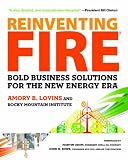
Bold Business Solutions for the New Energy Era
by Amory Lovins


Proof-backed recommendation
Amazon availability
Reinventing Fire reads like a strategic white paper extended into book form: methodical, example-rich, and oriented toward sector-level solutions for replacing oil, coal, and nuclear with cleaner alternatives. Its useful part is a clear, operationally-minded set of scenarios and business cases that show how demand-side efficiency plus supply shifts could change energy systems. The main limitation is tone and focus—strongly optimistic and prescriptive—so readers wanting gritty political limitations, personal stories, or short step-by-step actions may find it long on proposals and light on implementation friction.
This summary and audience guidance are AI-generated from the book's description and its recommendation history, last updated June 2026. Recommendations, quotes and sources elsewhere on this page come from published material and are not generated.
Imagine fuel without fear. No climate change. No oil spills, no dead coalminers, no dirty air, no devastated lands, no lost wildlife. No energy poverty. No oilfed wars, tyrannies, or terrorists. No leaking nuclear wastes or spreading nuclear weapons. Nothing to run out. Nothing to cut off. Nothing to worry about. Just energy abundance, benign and ...
Difficulty:hard
Check formats, pricing, and availability options for Kindle, physical print, or audiobooks directly.
View available editions on AmazonWhy recommended
Recommended by 4 sources and appears in Environment, Most Recommended Books, and Business.
People and public figures who have recommended this book.
Recommendation proof is sourced from public posts, interviews, reading lists, and cited references.
Ev Williams
Co-founder of Twitter and Medium
“I’ve read a lot about climate change. Mostly it’s depressing — which isn’t a good reason to not understand it. But this book from Amory Lovins and his Rocky Mountain Institute is an antidote for doom and gloom. It offers a thoroughly researched set of options for engineering our way out of the crisis.”
Check formats, pricing, and availability options directly on Amazon.
Consider Accidental Presidents by Jared Cohen. Recommended by 10 sources.
“Accidental Presidents offers eight narrative portraits of men who succeeded to the U.S. presidency without election, using anecdote-rich scenes and readable context to show how personality and circumstance interact with office power. It’s strongest as a set of self-contained stories that make succession stakes concrete for non-specialist readers; it does not prioritize dense archival argument or exhaustive methodology, so expect some interpretive generalizations and repeated themes across cases. Use it for fast historical orientation rather than scholarly deep-dives.”


Each recommendation is collected from a public source — interviews, articles, or curated lists — and linked to its original URL. Books with many verifiable recommendations from respected people rank higher.