
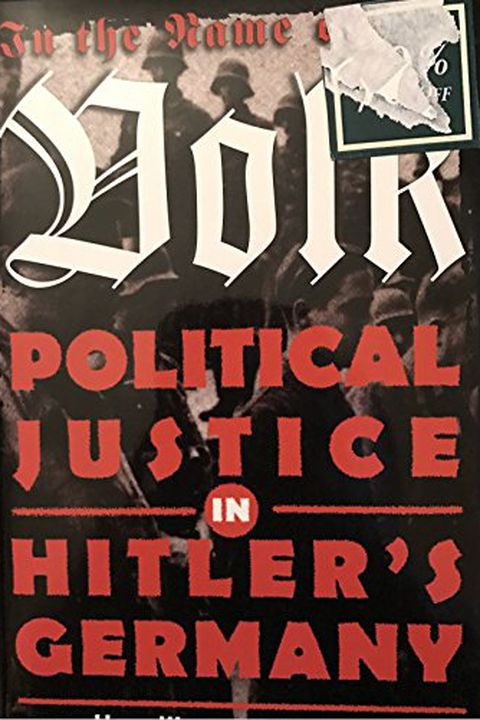
In the Name of the Volk
Political Justice in Hitler's Germany
by H. W. Koch
Amazon availability
Reading Profile
Should I read this?
In the Name of the Volk (H. W. Koch) reads like specialized legal history focused tightly on one institution and its leadership, with attention to how categories of guilt were framed in Nazi terms. The useful part is the close look at institutional power and the mechanics of legal labeling and procedure. The limiting part is that the narrow scope can feel relentless: it may stay more analytical than story-driven, and the tone can feel grimly distant.
Read this if...
- •A history grad student writing a seminar paper on authoritarianism and law, who needs a tight, court-linked case study of how “treason” was operationalized through legal categories and procedure (and you want something traceable at the wording/process level).
- •A Germany-history reader who already knows the general Nazi timeline but is now researching the judicial apparatus around the People’s Court for a class presentation, who wants additional detail on how legal framing worked after trials rather than a broad political overview.
- •A documentary-minded researcher building a character study of Roland Freisler as an institutional operator, who wants to understand how authority and legal category-making functioned from the inside—more than you want courtroom drama or speeches-as-story.
Skip this if...
- •You’ll likely put it down when you realize it isn’t trying to be a general survey of Nazi Germany; the narrow, court-focused approach and procedural emphasis can outlast your patience.
- •You may lose interest if you want emotionally warm storytelling, because the emphasis on definitions, institutions, and legal framing can feel cold or repetitive.
- •You’ll struggle to continue if you prefer ideologically “safe” or reassuring summaries; the subject matter stays blunt and heavy, with limited relief.
More than half a century after the Nuremberg trials, a respected researcher presents the littleknown history of the National Socialist People's Court, the infamous blueprint for defining treason in Nazi terms. Focusing on the architect of this court, Roland Freisler, who as president of the court had the power of a "subF...
Before You Buy
Reading Specifications
Difficulty:hard
Audience Fit
- A history grad student writing a seminar paper on authoritarianism and law, who needs a tight, court-linked case study of how “treason” was operationalized through legal categories and procedure (and you want something traceable at the wording/process level).
- A Germany-history reader who already knows the general Nazi timeline but is now researching the judicial apparatus around the People’s Court for a class presentation, who wants additional detail on how legal framing worked after trials rather than a broad political overview.
- A documentary-minded researcher building a character study of Roland Freisler as an institutional operator, who wants to understand how authority and legal category-making functioned from the inside—more than you want courtroom drama or speeches-as-story.
- You’ll likely put it down when you realize it isn’t trying to be a general survey of Nazi Germany; the narrow, court-focused approach and procedural emphasis can outlast your patience.
- You may lose interest if you want emotionally warm storytelling, because the emphasis on definitions, institutions, and legal framing can feel cold or repetitive.
- You’ll struggle to continue if you prefer ideologically “safe” or reassuring summaries; the subject matter stays blunt and heavy, with limited relief.
Check formats, pricing, and availability options for Kindle, physical print, or audiobooks directly.
View available editions on AmazonKey themes
Why recommended
appears in About Germany.
Recommendation Signals
Recommendation proof is sourced from public posts, interviews, reading lists, and cited references.
No verified recommendation proof available yet.
Ready to read In the Name of the Volk?
Check formats, pricing, and availability options directly on Amazon.
Appears In
Not sure if this is the right fit?
Consider Hitler by Ian Kershaw. Recommended by 3 sources.
“This is a thorough, chronological portrait that follows Adolf Hitler from obscure origins to his death in Berlin, written with a scholarly tone and attention to political context. What works best is its sustained focus on how personal biography and German institutions interacted across decades; expect deep background on parties, power struggles, and the wartime bureaucracy. The main limitation is pace: long stretches of administrative and political minutiae can feel repetitive and slow, which will frustrate readers seeking a brisk or anecdote-driven life story.”
Similar books

Berlin Diaries, 19401945
Marie Vassiltchikov
Fodor's Essential Germany
Fodor's Travel Guides

Children of a Vanished World
Mara Vishniac Kohn

Europa, Europa
Solomon Perel
German Survival Guide
Elizabeth BinghamHow recommendation signals are reviewed
Each recommendation is collected from a public source — interviews, articles, or curated lists — and linked to its original URL. Books with many verifiable recommendations from respected people rank higher.