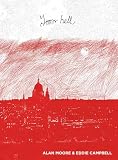
by Alan Moore
Alan Moore's From Hell is a long, slow-burn graphic novel that reconstructs notorious Victorian murders into an atmospherically grim, obsessive underworld. It rewards readers who enjoy layered storytelling: dense, dialogue-heavy panels, extended historical context, and unsettling visual sequences by the artist. What works best is its immersive, forensic atmosphere and moral ambiguity; its main limitation is relentless bleakness and periodic digressions into detail that feel repetitive, which can numb empathy and grind pacing for readers expecting a straightforward thriller.
This summary and audience guidance are AI-generated from the book's description and its recommendation history, last updated June 2026. Recommendations, quotes and sources elsewhere on this page come from published material and are not generated.
"I shall tell you where we are. We're in the most extreme and utter region of the human mind. A dim, subconscious underworld. A radiant abyss where men meet themselves. Hell, Netley. We're in Hell." Having proved himself peerless in the arena of reinterpreting superheroes, Alan Moore turned his everincisive eye to the squalid, enigmatic world of J...
Difficulty:hard
Check formats, pricing, and availability options for Kindle, physical print, or audiobooks directly.
View available editions on AmazonWhy recommended
appears in Comics, Horror, and Comics.
Recommendation proof is sourced from public posts, interviews, reading lists, and cited references.
No verified recommendation proof available yet.
Check formats, pricing, and availability options directly on Amazon.
Consider The Republic by Plato. Recommended by 13 sources.
“Plato stages an extended Socratic conversation that moves from concrete questions about justice into broad proposals about an ideal city, the structure of the soul, and what counts as reality and knowledge. Reading alternates brisk question-and-answer snippets with long, cumulative demonstrations that reward careful attention and annotation. Main value: a wealth of thought experiments for testing political and ethical intuitions. Main limitation: repetitive refutations, long policy sketches and dense metaphysical passages can feel abstruse and slow; patience and some philosophical background help.”
Each recommendation is collected from a public source — interviews, articles, or curated lists — and linked to its original URL. Books with many verifiable recommendations from respected people rank higher.