BookMentionsBookMentions
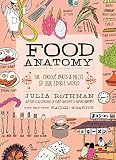
Food Anatomy

Food Anatomy

The Curious Parts & Pieces of Our Edible World

by Julia Rothman

Check price on Amazon

Proof-backed recommendation

Amazon availability

Reading Profile

Difficulty:easy
Themes:visual-facts vs deep-analysisplayful-tone vs cultural-seriousness

Should I read this?

Food Anatomy is a picture-forward, snackable guide that pairs Julia Rothman's hand-drawn art with short bits of history, ingredient notes, and global street-food snapshots. It works best as a coffee-table or kitchen-counter book that sparks curiosity and mealtime conversation—the visuals carry most of the appeal. The main limitation is depth: the tone stays light and often surface-level, so readers seeking culinary technique, full recipes, or rigorous cultural context will find it unsatisfying.

Read this if...

  • a graphic designer sketching a food-themed series who needs quirky, ready-made visual ideas and concise captions to jumpstart layouts
  • a home cook who enjoys food trivia and wants a visually appealing volume to flip through between chores or to spark dinner-table conversation
  • a middle-school teacher assembling a short, photo-and-illustration-driven unit on world foods that needs approachable, bite-sized background for students

Skip this if...

  • you want technical recipes, step-by-step technique, or a cookbook you can follow in the kitchen—this book has few practical recipes and no hands-on exercises
  • you'll likely put it down when the same illustrated-fact-per-page rhythm repeats; if you prefer sustained narrative or deep analysis, the format feels repetitive and shallow
  • annoying if you prefer fully sourced, citation-heavy writing—charm and visuals are prioritized over exhaustive documentation or academic depth

Get your recommended daily allowance of facts and fun with Food Anatomy, the third book in Julia Rothman?s bestselling Anatomy series. She starts with an illustrated history of food and ends with a global tour of street eats. Along the way, Rothman serves up a hilarious primer on short order egg lingo and a mouthwatering menu of how people around ...

Before You Buy

Reading Specifications

Difficulty:easy

Themes:
visual-facts vs deep-analysisplayful-tone vs cultural-seriousnessglobal-sweep vs local-detail

Audience Fit

Recommended for:
  • a graphic designer sketching a food-themed series who needs quirky, ready-made visual ideas and concise captions to jumpstart layouts
  • a home cook who enjoys food trivia and wants a visually appealing volume to flip through between chores or to spark dinner-table conversation
  • a middle-school teacher assembling a short, photo-and-illustration-driven unit on world foods that needs approachable, bite-sized background for students
Not ideal if you want:
  • you want technical recipes, step-by-step technique, or a cookbook you can follow in the kitchen—this book has few practical recipes and no hands-on exercises
  • you'll likely put it down when the same illustrated-fact-per-page rhythm repeats; if you prefer sustained narrative or deep analysis, the format feels repetitive and shallow
  • annoying if you prefer fully sourced, citation-heavy writing—charm and visuals are prioritized over exhaustive documentation or academic depth

Check formats, pricing, and availability options for Kindle, physical print, or audiobooks directly.

View available editions on Amazon

Key themes

visual-facts vs deep-analysisplayful-tone vs cultural-seriousnessglobal-sweep vs local-detailsnackable-trivia vs thorough-sourcing

Why recommended

appears in Nature, Food, and Art.

Recommendation Signals

Recommendation proof is sourced from public posts, interviews, reading lists, and cited references.

No verified recommendation proof available yet.

Appears In

Accidental Presidents
Try This Instead

Not sure if this is the right fit?

Consider Accidental Presidents by Jared Cohen. Recommended by 10 sources.

Accidental Presidents offers eight narrative portraits of men who succeeded to the U.S. presidency without election, using anecdote-rich scenes and readable context to show how personality and circumstance interact with office power. It’s strongest as a set of self-contained stories that make succession stakes concrete for non-specialist readers; it does not prioritize dense archival argument or exhaustive methodology, so expect some interpretive generalizations and repeated themes across cases. Use it for fast historical orientation rather than scholarly deep-dives.

Similar books

How recommendation signals are reviewed

Each recommendation is collected from a public source — interviews, articles, or curated lists — and linked to its original URL. Books with many verifiable recommendations from respected people rank higher.

Food Anatomy

Food Anatomy

View on Amazon →