
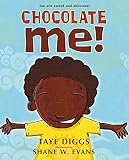
Chocolate Me!
by Taye Diggs
Reading Profile
Should I read this?
A short, image-driven picture book that works as a warm read-aloud: a boy upset about being teased for darker skin and curlier hair receives patient, specific praise from his mother that reframes his looks as beautiful. Its strength is direct, joyful language and striking illustrations that celebrate complexion and texture; its main limitation is simplicity—nuance about colorism, social causes, or coping strategies is minimal, so older children or adults wanting deeper discussion may find the reassurance repetitive rather than unpacked.
Read this if...
- •a parent of a 3–7-year-old whose child was teased about skin tone or hair texture, who needs simple, repeatable lines to reassure the child after school
- •an elementary school teacher preparing a short read-aloud for a diversity or anti-bullying circle, who wants an accessible visual story to open conversation
- •an adoptive or foster caregiver introducing appearance differences to a young child, who needs a gentle, picture-forward script that validates identity
Skip this if...
- •you'll likely put it down when you expect detailed guidance or historical context about colorism — the text stays reassuring rather than explanatory
- •annoying if you prefer subtle or complex narratives; the message is emotionally direct and can feel didactic to adults or older kids
- •not a fit if you want hands-on activities or discussion prompts built in — the book lacks exercises or lesson scaffolding
The boy is teased for looking different than the other kids. His skin is darker, his hair curlier. He tells his mother he wishes he could be more like everyone else. And she helps him to see how beautiful he really, truly is.For years before they both achieved acclaim in their respective professions, good friends Taye Diggs and Shane W. Evans wante...
Before You Buy
Reading Specifications
Difficulty:hard
Audience Fit
- a parent of a 3–7-year-old whose child was teased about skin tone or hair texture, who needs simple, repeatable lines to reassure the child after school
- an elementary school teacher preparing a short read-aloud for a diversity or anti-bullying circle, who wants an accessible visual story to open conversation
- an adoptive or foster caregiver introducing appearance differences to a young child, who needs a gentle, picture-forward script that validates identity
- you'll likely put it down when you expect detailed guidance or historical context about colorism — the text stays reassuring rather than explanatory
- annoying if you prefer subtle or complex narratives; the message is emotionally direct and can feel didactic to adults or older kids
- not a fit if you want hands-on activities or discussion prompts built in — the book lacks exercises or lesson scaffolding
Check formats, pricing, and availability options for Kindle, physical print, or audiobooks directly.
View available editions on AmazonKey themes
Why recommended
appears in Inclusion Diversity and Fiction.
Recommendation Signals
Recommendation proof is sourced from public posts, interviews, reading lists, and cited references.
No verified recommendation proof available yet.
Appears In
Not sure if this is the right fit?
Consider The Republic by Plato. Recommended by 13 sources.
“Plato stages an extended Socratic conversation that moves from concrete questions about justice into broad proposals about an ideal city, the structure of the soul, and what counts as reality and knowledge. Reading alternates brisk question-and-answer snippets with long, cumulative demonstrations that reward careful attention and annotation. Main value: a wealth of thought experiments for testing political and ethical intuitions. Main limitation: repetitive refutations, long policy sketches and dense metaphysical passages can feel abstruse and slow; patience and some philosophical background help.”
Similar books
How recommendation signals are reviewed
Each recommendation is collected from a public source — interviews, articles, or curated lists — and linked to its original URL. Books with many verifiable recommendations from respected people rank higher.