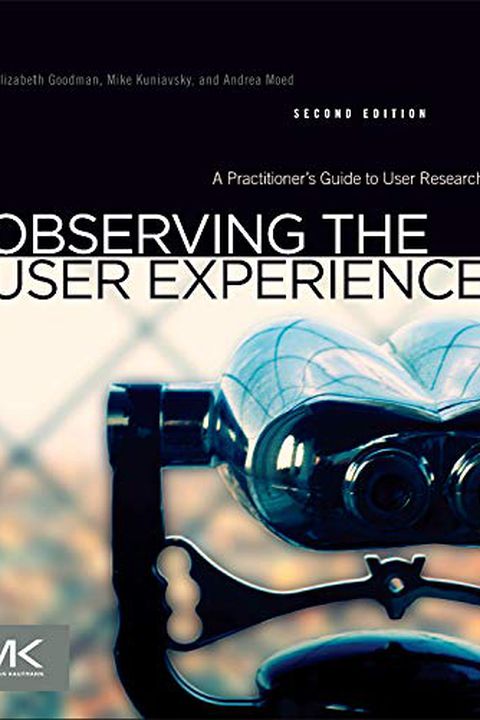
A Practitioner's Guide to User Research
by Elizabeth Goodman School of Information University of California Berkeley
Starts with a clear problem statement—designers and developers often imagine users; this book supplies concrete ways to close that gap. It presents field methods, interview and usability techniques, recruitment advice, and tips for turning observations into product decisions. Most useful for teams who need step-by-step study workflows and sample cases. Limitation: method-heavy chapters and repeated procedural detail make some sections slow; it also lacks hands-on exercises, so you’ll need your own project to apply the techniques.
This summary and audience guidance are AI-generated from the book's description and its recommendation history, last updated May 2026. Recommendations, quotes and sources elsewhere on this page come from published material and are not generated.
The gap between who designers and developers imagine their users are, and who those users really are can be the biggest problem with product development. "Observing the User Experience" will help you bridge that gap to understand what your users want and need from your product, and whether they'll be able to use what you've created. Filled with rea...
Difficulty:hard
Check formats, pricing, and availability options for Kindle, physical print, or audiobooks directly.
View available editions on AmazonWhy recommended
appears in Design, Design, and Art.
Recommendation proof is sourced from public posts, interviews, reading lists, and cited references.
No verified recommendation proof available yet.
Check formats, pricing, and availability options directly on Amazon.
Consider Accidental Presidents by Jared Cohen. Recommended by 10 sources.
“Accidental Presidents offers eight narrative portraits of men who succeeded to the U.S. presidency without election, using anecdote-rich scenes and readable context to show how personality and circumstance interact with office power. It’s strongest as a set of self-contained stories that make succession stakes concrete for non-specialist readers; it does not prioritize dense archival argument or exhaustive methodology, so expect some interpretive generalizations and repeated themes across cases. Use it for fast historical orientation rather than scholarly deep-dives.”

Each recommendation is collected from a public source — interviews, articles, or curated lists — and linked to its original URL. Books with many verifiable recommendations from respected people rank higher.