
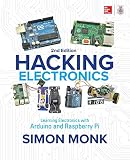
Hacking Electronics
Learning Electronics with Arduino and Raspberry Pi, Second Edition
by Simon Monk
Amazon availability
Reading Profile
Should I read this?
Hacking Electronics is a hands-on maker's manual that guides you through wiring, disassembly, tweaks and repurposing for Arduino and Raspberry Pi projects. It reads like a sequence of short weekend builds: clear photos, step lists, and pragmatic tips that get a circuit working without drowning in equations. The most useful part is quick, practical tricks that revive old modules and solve common hookup headaches. Limitations: explanations sometimes trade depth for speed, so readers who want rigorous electronics theory will find it shallow.
Read this if...
- •a hobbyist with a box of leftover sensors and a weekend free who wants practical fixes and wiring recipes to get projects running without designing circuits from scratch
- •a classroom instructor preparing short demos who needs approachable, visual steps and ready-to-run examples to show students basic hardware tricks in one lab session
- •a startup prototype engineer making quick proof-of-concept builds who needs hacks to reuse parts, speed up wiring, and move from idea to working demo fast
Skip this if...
- •you'll likely put it down when long, repetitive step-by-step photo sequences replace conceptual explanation — tedious if you prefer fast conceptual overviews
- •annoying if you want rigorous circuit analysis or mathematical explanation; the book favors practical workarounds over deep theory
- •not for purely-software developers who want zero hardware fuss — it's hands-on and assumes you'll be soldering, wiring and handling components
Publisher's Note: Products purchased from Third Party sellers are not guaranteed by the publisher for quality, authenticity, or access to any online entitlements included with the product. Uptodate hacks that will breathe life into your Arduino and Raspberry Pi creations!This intuitive DIY guide shows how to wire, disassemble, tweak, and repurpo...
Before You Buy
Reading Specifications
Difficulty:hard
Audience Fit
- a hobbyist with a box of leftover sensors and a weekend free who wants practical fixes and wiring recipes to get projects running without designing circuits from scratch
- a classroom instructor preparing short demos who needs approachable, visual steps and ready-to-run examples to show students basic hardware tricks in one lab session
- a startup prototype engineer making quick proof-of-concept builds who needs hacks to reuse parts, speed up wiring, and move from idea to working demo fast
- you'll likely put it down when long, repetitive step-by-step photo sequences replace conceptual explanation — tedious if you prefer fast conceptual overviews
- annoying if you want rigorous circuit analysis or mathematical explanation; the book favors practical workarounds over deep theory
- not for purely-software developers who want zero hardware fuss — it's hands-on and assumes you'll be soldering, wiring and handling components
Check formats, pricing, and availability options for Kindle, physical print, or audiobooks directly.
View available editions on AmazonKey themes
Why recommended
appears in Raspberry Pi.
Recommendation Signals
Recommendation proof is sourced from public posts, interviews, reading lists, and cited references.
No verified recommendation proof available yet.
Ready to read Hacking Electronics?
Check formats, pricing, and availability options directly on Amazon.
Appears In
Not sure if this is the right fit?
Consider Programming, the Raspberry Pi, Second Edition by Simon Monk.
Similar books

Creative Projects with Raspberry Pi
Ms. Kirsten Kearney
How recommendation signals are reviewed
Each recommendation is collected from a public source — interviews, articles, or curated lists — and linked to its original URL. Books with many verifiable recommendations from respected people rank higher.