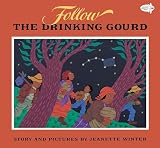
by Jeanette Winter
Jeanette Winter retells the Peg Leg Joe/drinking gourd folktale with spare text and full-color paintings that favor atmosphere over detail. Reading tends toward a lullaby cadence, making it easy to read aloud and to use as a prompt for questions or a sing-along activity. The useful part is sparking curiosity about escape routes without graphic detail; the limiting part is a near-total lack of historical context and very archetypal characters. Best used as a gentle gateway for discussion, not as a factual classroom source.
This summary and audience guidance are AI-generated from the book's description and its recommendation history, last updated June 2026. Recommendations, quotes and sources elsewhere on this page come from published material and are not generated.
Illus. in full color. "Winter's story begins with a pegleg sailor who aids slaves on their escape on the Underground Railroad. While working for plantation owners, Peg Leg Joe teaches the slaves a song about the drinking gourd (the Big Dipper). A couple, their son, and two others make their escape by following the song's directions. Rich paintings...
Difficulty:hard
Check formats, pricing, and availability options for Kindle, physical print, or audiobooks directly.
View available editions on AmazonWhy recommended
appears in Civil War.
Recommendation proof is sourced from public posts, interviews, reading lists, and cited references.
No verified recommendation proof available yet.
Check formats, pricing, and availability options directly on Amazon.
Consider Battle Cry of Freedom by James M. McPherson. Recommended by 1 sources.
“James M. McPherson delivers a fast-paced, single-volume narrative that moves between politics, society, and combat to produce a connected chronology and a clear interpretive stance. The useful payoff is a coherent timeline that helps you see cause-and-effect across campaigns, policy shifts, and public opinion. The main limitation is emphasis and compression: long battle sections can feel dense, and selective choices about which episodes receive space will frustrate readers who want exhaustive local detail or a heavily annotated, apparatus-driven history.”




Each recommendation is collected from a public source — interviews, articles, or curated lists — and linked to its original URL. Books with many verifiable recommendations from respected people rank higher.
