
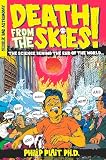
Death from the Skies!
The Science Behind the End of the World
by Philip Plait
Amazon availability
Reading Profile
Should I read this?
Philip Plait uses gripping disaster scenarios to teach basic astronomy, turning black holes, supernovae, and gamma-ray bursts into memorable thought experiments. The useful part is plain-language metaphors and risk-minded comparisons that make why these events matter easy to picture without math. The limiting part is a tone that leans on dramatic hooks and skips heavy technical detail, so readers seeking rigorous derivations or cautious probabilistic arguments will feel shortchanged. Best read in short sittings or as a lively supplemental primer.
Read this if...
- •high-school science teacher prepping a short unit on space hazards who needs vivid anecdotes and clear metaphors to hook students across a few lessons
- •busy non-specialist curious about astronomy who wants a one- or two-sitting primer on why events like supernovae or gamma-ray bursts matter without wading through equations
- •podcast host or public-lecture presenter assembling short, attention-getting explanations and metaphors for a segment about astronomical risks
Skip this if...
- •you’ll likely put it down when the apocalypse framing repeats — readers wanting steadily deeper technical detail often stop after the first few sensational chapters
- •annoying if you prefer sober, data-first writing: the book favors dramatic scenarios over dense statistics or formal modeling
- •not a fit if you want problem sets, hands-on exercises, or rigorous mathematical derivations — it lacks hands-on exercises and deep math
A lively astronomy primer that uses cataclysmic scenarios to explain the universe's most fascinating events.According to astronomer Dr Philip Plait, the universe is an apocalypse waiting to happen, but how much do we really need to fear from things like black holes, gammaray bursts, and supernovae And if we should be scared, is there anything we ...
Before You Buy
Reading Specifications
Difficulty:hard
Audience Fit
- high-school science teacher prepping a short unit on space hazards who needs vivid anecdotes and clear metaphors to hook students across a few lessons
- busy non-specialist curious about astronomy who wants a one- or two-sitting primer on why events like supernovae or gamma-ray bursts matter without wading through equations
- podcast host or public-lecture presenter assembling short, attention-getting explanations and metaphors for a segment about astronomical risks
- you’ll likely put it down when the apocalypse framing repeats — readers wanting steadily deeper technical detail often stop after the first few sensational chapters
- annoying if you prefer sober, data-first writing: the book favors dramatic scenarios over dense statistics or formal modeling
- not a fit if you want problem sets, hands-on exercises, or rigorous mathematical derivations — it lacks hands-on exercises and deep math
Check formats, pricing, and availability options for Kindle, physical print, or audiobooks directly.
View available editions on AmazonKey themes
Why recommended
appears in Best Science Books and Nonfiction.
Recommendation Signals
Recommendation proof is sourced from public posts, interviews, reading lists, and cited references.
No verified recommendation proof available yet.
Ready to read Death from the Skies!?
Check formats, pricing, and availability options directly on Amazon.
Appears In
Not sure if this is the right fit?
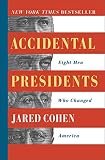
Consider Accidental Presidents by Jared Cohen. Recommended by 10 sources.
“Accidental Presidents offers eight narrative portraits of men who succeeded to the U.S. presidency without election, using anecdote-rich scenes and readable context to show how personality and circumstance interact with office power. It’s strongest as a set of self-contained stories that make succession stakes concrete for non-specialist readers; it does not prioritize dense archival argument or exhaustive methodology, so expect some interpretive generalizations and repeated themes across cases. Use it for fast historical orientation rather than scholarly deep-dives.”
Similar books

How recommendation signals are reviewed
Each recommendation is collected from a public source — interviews, articles, or curated lists — and linked to its original URL. Books with many verifiable recommendations from respected people rank higher.