
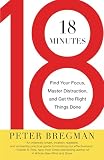
18 Minutes
Find Your Focus, Master Distraction, and Get the Right Things Done
by Peter Bregman
Reading Profile
Should I read this?
Peter Bregman's 18 Minutes is a brisk, advice-driven handbook built from short columns, offering a handful of repeatable habits to pick daily priorities, reduce busywork, and reclaim attention. Most chapters are short, practical, and oriented toward immediate changes—good for people who prefer tactic over theory. Its limitation: tips can feel repetitive and anecdotal, with little academic justification or deep case studies; readers who want step-by-step exercises or scientific grounding may find it lightweight.
Read this if...
- •a mid-level manager at a fast-growing startup trying to stop meetings from swallowing the week — because the book gives quick rituals and decision rules you can test in daily rhythms
- •a small-business owner juggling operations, sales, and staffing who only has short reading windows — because chapters are bite-sized and designed for immediate application
- •an individual contributor returning from extended leave who needs a simple daily plan to rebuild focus — because the book offers short, repeatable steps rather than long strategic resets
Skip this if...
- •you’ll likely put it down when the same tip is restated with new anecdotes — if repetition and column-style reiteration frustrate you, this is the drop-off point
- •annoying if you prefer deep evidence or theory — the book favors practical maxims over academic backing or long-form analysis
- •not for readers who want a workbook or structured exercises — contains suggestions but lacks hands-on templates and guided practice
Based upon his weekly Harvard Business Review columns (which is one of the most popular columns on HBR.com, receiving hundreds of thousands of unique page views a month), 18 Minutes clearly shows how busy people can cut through all the daily clutter and distractions and find a way to focus on those key items which are truly the top priorities in ou...
Before You Buy
Reading Specifications
Difficulty:hard
Audience Fit
- a mid-level manager at a fast-growing startup trying to stop meetings from swallowing the week — because the book gives quick rituals and decision rules you can test in daily rhythms
- a small-business owner juggling operations, sales, and staffing who only has short reading windows — because chapters are bite-sized and designed for immediate application
- an individual contributor returning from extended leave who needs a simple daily plan to rebuild focus — because the book offers short, repeatable steps rather than long strategic resets
- you’ll likely put it down when the same tip is restated with new anecdotes — if repetition and column-style reiteration frustrate you, this is the drop-off point
- annoying if you prefer deep evidence or theory — the book favors practical maxims over academic backing or long-form analysis
- not for readers who want a workbook or structured exercises — contains suggestions but lacks hands-on templates and guided practice
Check formats, pricing, and availability options for Kindle, physical print, or audiobooks directly.
View available editions on AmazonKey themes
Why recommended
appears in Time Management, Personal Development, and Business.
Recommendation Signals
Recommendation proof is sourced from public posts, interviews, reading lists, and cited references.
No verified recommendation proof available yet.
Appears In
Not sure if this is the right fit?
Consider Accidental Presidents by Jared Cohen. Recommended by 10 sources.
“Accidental Presidents offers eight narrative portraits of men who succeeded to the U.S. presidency without election, using anecdote-rich scenes and readable context to show how personality and circumstance interact with office power. It’s strongest as a set of self-contained stories that make succession stakes concrete for non-specialist readers; it does not prioritize dense archival argument or exhaustive methodology, so expect some interpretive generalizations and repeated themes across cases. Use it for fast historical orientation rather than scholarly deep-dives.”
Similar books


How recommendation signals are reviewed
Each recommendation is collected from a public source — interviews, articles, or curated lists — and linked to its original URL. Books with many verifiable recommendations from respected people rank higher.